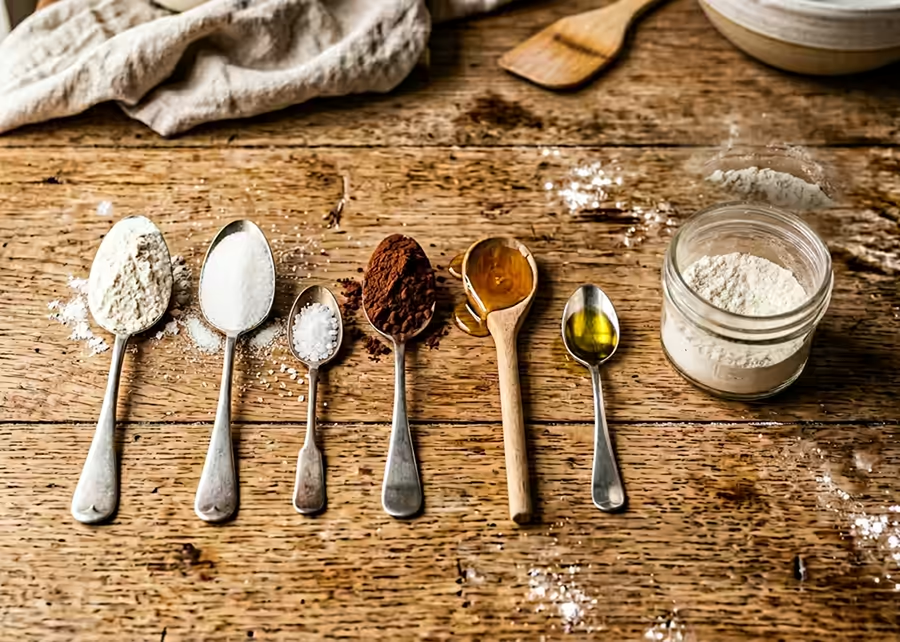
When you don’t have kitchen scales or they are “somewhere in the cupboard,” a tablespoon, teaspoon, and ordinary glass will come to the rescue. But there is an important nuance: a spoon and a glass measure volume, while grams measure mass. That is why 1 tablespoon of flour, 1 tablespoon of sugar, and 1 tablespoon of salt have different weights.
This article is a practical guide for those looking for answers to questions such as: “How many grams are in a tablespoon?”, “How many grams are in a teaspoon?” and “How many grams are in a glass (cup)?” Here you will find tables for the most popular ingredients (flour, sugar, salt, cocoa, starch, honey, oil, cereals, etc.), as well as tips on how to measure correctly so that your recipes turn out consistently.
Let’s agree right away: in this article, “glass” means a glass with a volume of 200 ml. This is convenient, familiar to many home recipes, and well suited as a basic measure.
Content
Why a spoonful isn’t always “15 grams”
The common phrase “15 grams in a tablespoon” is only true for water and liquids with a similar density. Water fills the spoon evenly, so 1 tablespoon of water is indeed about (15) grams. But for oil, honey, or flour, the weight will be different.
The reason is simple: mass depends on density. The same spoon has approximately the same volume, but different products have different “weights” in this volume. Therefore, the tables below are guidelines for home cooking, not laboratory values.
“Without a slide” or “with a slide”: what it means and how it affects
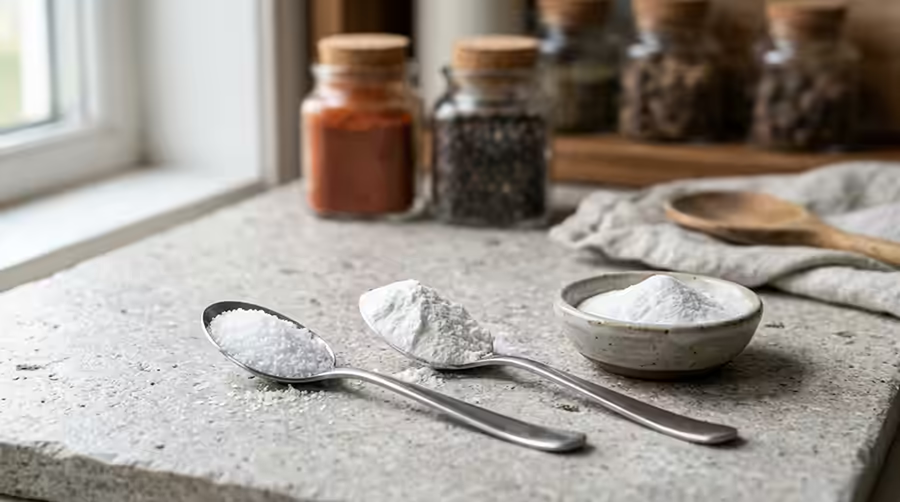
In most recipes, unless otherwise stated, a level spoon is implied. This means that you have poured the product and leveled the top with a knife or spatula. “Heaped” can add a very noticeable error, especially for flour, cocoa, starch, and powdered sugar.
For salt, “heaped” is also critical, because it is easy to oversalt a dish. For baking powder or soda, overdoing it can ruin the taste and texture of baked goods. If the recipe says “heaped,” it is better to take this as a separate measure and try to make the heap the same every time.
Volume standards: tablespoon, teaspoon, 200 ml glass
To make the conversions easier to understand, let’s take the most common culinary volumes:
- Tablespoon: approximately (15) ml
- Teaspoon: approximately (5) ml
- 1 tablespoon = 3 teaspoons (by volume)
- Glass: (200) ml
If your spoons are too small or, conversely, too deep, the readings may be inaccurate. However, for most home sets, these guidelines work quite consistently.
How to measure ingredients correctly with a spoon and a glass
For loose products (flour, sugar, cocoa, starch), it is important to use the same technique. Scoop up the product with a spoon, do not tamp it down, then remove the “cap” with a smooth movement of the knife. Do not shake the spoon, as shaking will compact the product and increase its weight.
For thick products (honey, sour cream, mayonnaise), try to avoid air pockets. Fill the container tightly and level the top if you want consistency. For honey, a slightly warmed spoon or a thin layer of oil will help, as the honey will flow faster.
For a 200 ml glass, the rule is even simpler: fill it to the brim without heaping it up. If you tap the glass on the table, the loose product may compact, and the glass will contain more grams than indicated in the table. Choose one method and stick to it consistently.
How many grams are in a tablespoon: universal table (1 tbsp. without a slide)
Below are the average values for 1 tablespoon without a slide. For liquids, the figures are more stable, for bulk products — they vary slightly due to moisture and grinding.
| Ingredient | 1 tbsp, g (approx.) |
|---|---|
| Water | 15 |
| Milk | 15 |
| Drinking cream | 15 |
| Kefir / liquid yogurt | 15 |
| Vinegar (9%) | 15 |
| Soy sauce | 15–16 |
| Sunflower/olive oil | 13–14 |
| Melted butter | 13–14 |
| Soft butter | 14–15 |
| Sour cream (15–20%) | 18–20 |
| Mayonnaise | 18–20 |
| Liquid honey | 20–22 |
| Syrups (like maple syrup) | 18–22 |
| Tomato paste | 18–20 |
| Mustard | 15–18 |
| Wheat flour | 8–10 |
| Rye flour | 7–9 |
| Sugar | 12–13 |
| Brown sugar (loose) | 10–12 |
| Powdered sugar | 8–10 |
| Fine salt | 18–20 |
| Rock salt (coarse) | 16–18 |
| Cocoa powder | 7–9 |
| Starch (corn/potato) | 8–10 |
| Semolina | 10–12 |
| Syrian rice | 12–15 |
| Buckwheat | 12–14 |
| Bulgur | 12–14 |
| Millet | 12–14 |
| Pearl barley | 12–14 |
| Oat flakes | 5–7 |
| Coconut flakes | 5–7 |
| Breadcrumbs | 7–9 |
| Chopped nuts | 7–10 |
| Raisins | 10–12 |
| Dry yeast | 8–9 |
| Loosener | 10–12 |
| Soda | 12–14 |
| Powdered gelatin | 8–10 |
| Ground coffee | 5–7 |
| Leaf tea | 2–3 |
| Ground black pepper | 5–6 |
If you measure flour with a tablespoon, keep in mind the type of flour. Sifted flour is lighter, while flour that has settled in the bag is often denser. This is a common reason why the same recipe sometimes calls for “a little more flour.”
How many grams are in a teaspoon: table (1 tsp without a heap)
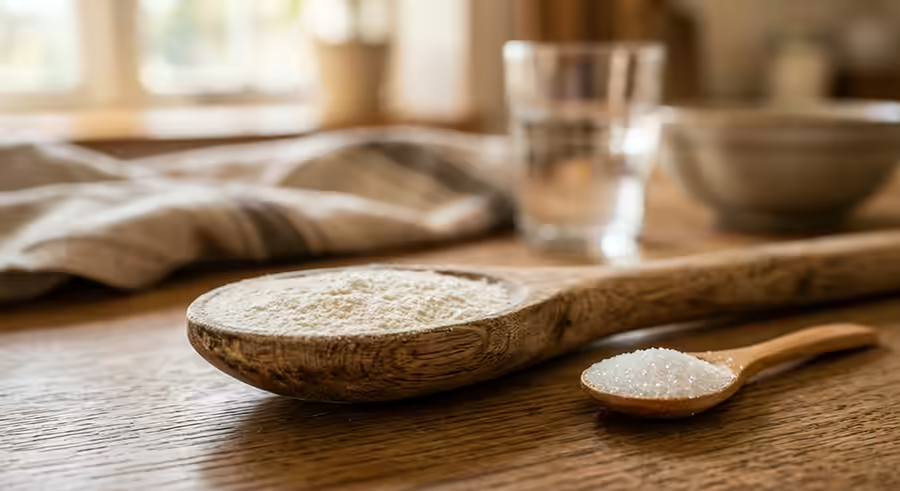
A teaspoon is most often needed for salt, baking soda, baking powder, spices, and vanilla sugar. Here, the margin of error from a “heaped” spoon is particularly noticeable, so aim for a level spoon.
| Ingredient | 1 tsp, g (approx.) |
|---|---|
| Water | 5 |
| Milk | 5 |
| Vinegar (9%) | 5 |
| Soy sauce | 5–5.5 |
| Oil | 4–5 |
| Honey | 7–8 |
| Sour cream | 6–7 |
| Mayonnaise | 6–7 |
| Wheat flour | 2.5–3.5 |
| Sugar | 4–5 |
| Brown sugar (loose) | 3.5–4.5 |
| Powdered sugar | 2.5–3.5 |
| Fine salt | 6–7 |
| Coarse salt | 5–6 |
| Cocoa | 2–3 |
| Starch | 2.5–3.5 |
| Semolina | 3–4 |
| Loosener | 4–5 |
| Soda | 4–5 |
| Dry yeast | 3 |
| Gelatin | 3–4 |
| Vanilla sugar | 4–5 |
| Ground cinnamon | 2–3 |
| Turmeric | 2 |
| Paprika | 2–3 |
| Ground pepper | 2 |
| Lemon salt | 5 |
If a recipe calls for a “pinch,” it is usually less than (1/8) teaspoon. For strong spices (pepper, cinnamon, ground cloves), a “pinch” may be enough, even if it seems too little.
How many grams are in a 200 ml glass: a large table for the kitchen
A 200 ml glass is convenient because it allows you to quickly measure out grains, flour, sugar, and liquids. For water, it’s simple: 200 ml of water ≈ 200 g. For other products, see the guidelines below.
| Ingredient | Glass 200 ml, g (approx.) |
|---|---|
| Water | 200 |
| Milk | 200 |
| Kefir / drinking yogurt | 200 |
| Drinking cream | 200 |
| Vinegar (9%) | 200 |
| Oil | 180–185 |
| Honey | 280–300 |
| Sour cream | 200–220 |
| Mayonnaise | 200–220 |
| Wheat flour | 125–135 |
| Rye flour | 110–130 |
| Sugar | 160–180 |
| Brown sugar (loose) | 130–160 |
| Powdered sugar | 100–120 |
| Fine salt | 250–280 |
| Coarse salt | 220–260 |
| Cocoa | 90–110 |
| Starch | 120–140 |
| Semolina | 160–180 |
| Syrian rice | 170–190 |
| Buckwheat | 160–180 |
| Bulgur | 150–170 |
| Millet | 160–180 |
| Pearl barley | 160–180 |
| Oat flakes | 70–90 |
| Couscous | 160–180 |
| Breadcrumbs | 90–110 |
| Coconut flakes | 60–80 |
| Chopped nuts | 90–120 |
| Raisins | 140–160 |
| Poppy | 120–140 |
When you see “1 cup of flour” in a recipe, always check whether the author is referring to 200 ml. This is often the case in Ukrainian home recipes, so these measurements are particularly relevant for your 200 ml cup.
Most popular: how many grams of flour, sugar, and salt are in a spoonful?
It is these ingredients that most often “float” in baked goods, so I am duplicating the key values separately. This is convenient if you want to quickly find the answer without looking through large tables.
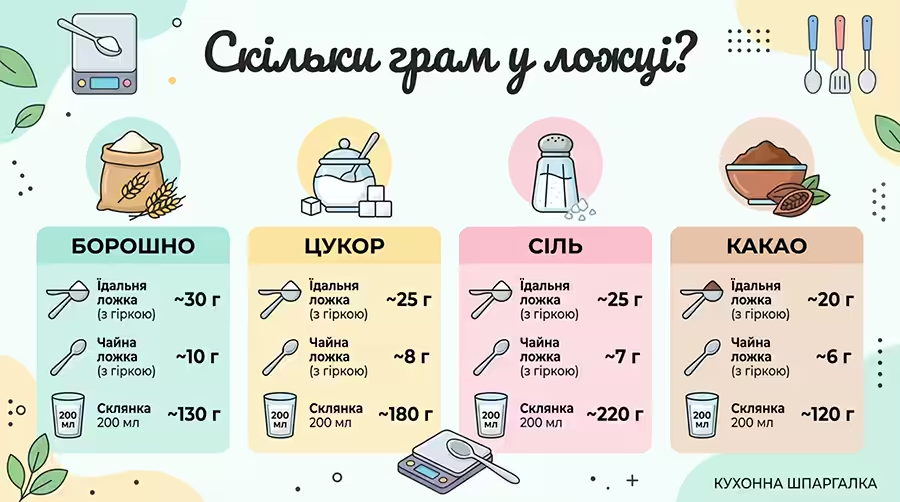
- Wheat flour: 1 tbsp. ≈ (8–10) g, 1 tsp. ≈ (2.5–3.5) g, 1 cup (200) ml ≈ (125–135) g
- Sugar: 1 tbsp. ≈ (12–13) g, 1 tsp. ≈ (4–5) g, 1 cup (200) ml ≈ (160–180) g
- Fine salt: 1 tbsp. ≈ (18–20) g, 1 tsp. ≈ (6–7) g, 1 cup (200) ml ≈ (250–280) g
If you want to get the most out of your baking, weigh the flour, sugar, and butter. But if you’re making simple cupcakes, pancakes, crepes, or sauces, these guidelines usually give consistent results.
Quick conversions without scales: useful formulas for the kitchen
When the recipe is in grams and you only have spoons, you can quickly estimate. Take the values from the tables and calculate the approximate number of spoons. For convenience, keep in mind that 1 tablespoon is 3 teaspoons, and a glass (200 ml) is approximately (13.3) tablespoons by volume.
Volume guidelines (works well for water/milk):
- 1 cup (200) ml ≈ 13 tbsp + 1 tsp (because (200/15 \approx 13.3))
- 100 ml ≈ 6 tbsp + 2 tsp (because (100/15 \approx 6.7))
- 50 ml ≈ 3 tbsp + 1 tsp (because (50/15 \approx 3.3))
For bulk products, these volume ratios do not give you the exact weight in grams, but they help you “convert” the recipe if the author wrote it in cups and you are more comfortable using spoons.
Examples: how to measure the required grams without kitchen scales
Example 1: You need (120) g of flour. If 1 cup (200) ml of flour ≈ (130) g, you need a little less than a full cup. In practice, this is about (0.9) cups, or 1 cup minus 1–2 tablespoons.
Example 2: You need (100) g of sugar. If 1 cup (200) ml of sugar ≈ (170) g, then (100) g is approximately (0.6) cups. If measured in tablespoons: (100/12.5 \approx 8), i.e. about 8 tablespoons without a heap.
Example 3: You need (10) g of salt. If 1 teaspoon of fine salt is ≈ (6–7) g, then (10) g is approximately 1.5 teaspoons without a heap. This is fine for soup, but for pickling or dough, it is better to add it gradually and taste as you go.
Liquids: water, milk, oil, vinegar, sauces
Liquids are easier because they fill a spoon predictably. If the recipe specifies milliliters, you can convert them to spoons with almost no loss of accuracy. For water and milk, the ratio “ml ≈ g” works almost perfectly, so 1 cup (200) ml is approximately (200) g.
The situation is different with oil and honey: they weigh differently for the same volume. If you are counting calories or making a sauce where consistency is important, remember that 1 tablespoon of oil is approximately (13–14) g, not (15) g.
Another nuance is viscous sauces. Soy sauce is similar to water, while thick syrups or honey can weigh more on a spoon. If the honey is cold, it will form a “cap,” and you will easily get more than you planned.
Baking powders: flour, cocoa, starch, baking soda, baking powder
The biggest problems in baking arise when flour is measured “as it comes.” If you scoop up flour with a spoon and press it down, the weight increases and the dough becomes stiff. If the flour is sifted and light, there will be fewer grams in the spoon, and the dough may turn out thinner.
Cocoa powder and starch are also “airy” and easily compacted. Therefore, there is one rule: scoop, level, do not tamp down. For baking soda and baking powder, accuracy is also important for taste: excess baking soda gives a soapy taste, and too much baking powder can make the structure crumbly.
If you often bake biscuits, eclairs, or complex cakes, the best purchase for stability is a simple kitchen scale. But if the task is daily home baking, tables with spoons and a glass (200 ml) are quite sufficient.
Cereals, flakes, dried fruits: what you need to know
Cereals are usually measured with a glass because it is faster. The shape and size of the grain are important here: rice fits more tightly in a glass than oat flakes. Oatmeal in a glass is “airy,” so it weighs less.
Dried fruits and raisins have another problem: they can vary in size and moisture content. A glass (200 ml) of raisins contains approximately (140–160) g, but if the raisins are very large and dry, there may be less. This is rarely critical for a cake, but it can sometimes be noticeable when it comes to the exact proportions of the filling.
When cooking porridge, it is often the ratio rather than the grams that matters. For example, “1 cup of cereal to 2 cups of water” gives the expected result, even if your cup is filled a little more tightly.
Thick dairy products and pastes: sour cream, mayonnaise, tomato paste
Sour cream and mayonnaise are easy to measure with spoons, but only if you scoop them without leaving any air pockets. If you scoop “lightly” and leave air pockets, the actual weight will be less. This can affect sauces, dressings, and muffin batter, where moisture and fat content are important.
Tomato paste is a dense product, and 1 tablespoon often weighs about (18–20) g. If you are making a sauce or borscht, the margin of error is not critical. But if you are preparing a marinade, where the balance of acid and salt is important, it is better to use the same method of measurement.
Mini ingredients: yeast, gelatin, spices
Dry yeast is often measured in grams, but in everyday life it is measured with spoons. As a guide: 1 teaspoon of dry yeast ≈ (3) g, and 1 tablespoon ≈ (8–9) g. If the recipe calls for (7) g, this is approximately 2 teaspoons without a heap.
Gelatin is also often measured with a spoon, but here the granules can vary in “fluffiness.” On average, 1 teaspoon ≈ (3–4) g, 1 tablespoon ≈ (8–10) g. For panna cotta, mousses, and jellies, it is better not to make a “high mound” so that the dessert does not turn out rubbery.
Spices vary greatly in density and grind. Therefore, the tables will always give approximate amounts, which is normal. If in doubt, add gradually, stir, and taste, especially with hot spices.
FAQ: answers to frequently asked questions
How many grams are in a tablespoon of flour?
On average (8–10) grams without a heap, depending on the flour and how it is measured.
How many grams are in a tablespoon of sugar?
Approximately (12–13) g without a heap.
How many grams are there in a tablespoon of salt?
Fine salt ≈ (18–20) g without a heap, coarse salt ≈ (16–18) g.
How many grams are in a teaspoon of salt?
Fine ≈ (6–7) g, coarse ≈ (5–6) g.
How many grams are there in a 200 ml glass of flour?
Approximately (125–135) g (without tamping).
How many grams are there in a 200 ml glass of sugar?
Approximately (160–180) g.
Why are the figures different in different tables? The volume of spoons/glasses, whether they are “heaped” or not, the
moisture content of the product, and the degree of compaction all have an impact.
Which is more accurate for bulk products: a spoon or a glass? It
is often more convenient and stable to measure with a glass (200 ml), but only if the filling method is the same.
A cheat sheet that is convenient to save
Here is a short list of values that are most often needed on a daily basis:
- 1 tablespoon of water ≈ (15) g, 1 teaspoon of water ≈ (5) g
- 1 cup (200) ml of water = (200) g
- 1 tbsp. flour ≈ (9) g, 1 cup (200) ml flour ≈ (130) g
- 1 tbsp sugar ≈ (12–13) g, 1 cup (200) ml sugar ≈ (170) g
- 1 teaspoon of salt ≈ (6–7) g, 1 tablespoon of salt ≈ (19) g
If you cook often, you can even print out these lines and stick them on the inside of your kitchen cabinet. This saves time and reduces the number of “googles” while cooking.