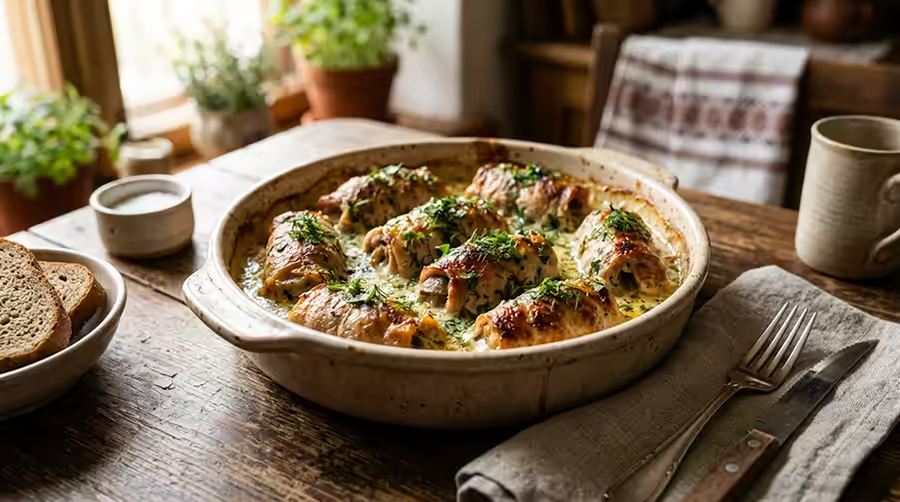
These are dishes that are easy to make for dinner. Meat rolls are just one of them. Thin slices of meat, the appetizer you stuff in the middle, a lower sauce — and it’s already on the table in no time, something homemade and hearty that you want to prepare again. The recipe is not restrictive, the products are simple, and the variations are almost limitless. Today we will break it all down: from the choice of meat to how to properly roll it so it doesn’t fall apart in the pan.
Content
What are meat rolls
Meat rolls as a Ukrainian meat dish
Meat rolls are meat rolls with filling, usually starting by wrapping, then frying or cooking in sauce. The dish is traditional for Ukrainian cuisine. In different regions, they are also known as stuffed meat rolls or their variations. The idea is simple: take a thin slice of meat, place the filling, and tightly wrap and secure it. Then — either bake with a lid or in a oven. Both cooking methods yield good results.
What distinguishes meat rolls from ordinary cutlets is the juiciness of the filling. It can be creamy (similar to cheese with greens) or savory (like mushrooms with nuts, blackcurrants, or berries). The filling also defines the character of the dish: whether it’s an everyday dinner or a festive presentation.
What meat is suitable: pork, chicken or turkey
In practice, three options are most commonly encountered.
Pork — the most common choice for home cooking. It is ground with fat or corned sometimes into a thin layer; it doesn’t tear when fried and remains juicy after cooking. The tenderloin is perfect — it can be used with any filling.
Chicken fillet — a lighter and faster option. It cooks faster than pork and retains the shape of the roll well. An important moment: chicken fillet is thinner and more fragile, so it needs to be rolled accurately to avoid tearing.
Yalovychyna — a larger portion of meat, but it also requires more preparation. It is more suitable for roasting, while braising takes longer. For beginners, it is better to start with pork or chicken.
There is also a variant with mixed spices — but this is already a different dish, not just roasted in the traditional sense.
Ingredients for the basic recipe
Base: meat, salt, pepper, oil
For 4–5 servings you will need:
Meat:
- 600–700 g of pork (shoulder or belly) or chicken fillet
- 1 tbsp salt
- ½ tsp black ground pepper
- 2 tbsp mustard or olive oil
For seasoning and sauce:
- 1 medium onion
- 200 g sour cream (15–20%)
- 100 ml white wine or water
- 1 bay leaf
- salt and pepper to taste
Starts: cheese, mushrooms, black pepper, greens
Below — pick for each of the four starters. Choose one or combine them.
Cheese and greens (base):
- 150 g hard or semi-hard cheese
- 2–3 cloves of garlic
- a handful of fresh herbs or parsley
Mushrooms:
- 250 g fresh mushrooms or other types of mushrooms
- 1 small onion
- 1 tbsp oil for seasoning
- if desired — 50 g grated cheese for binding
Black pepper:
- 10–12 pieces of fresh black pepper (without seeds)
- if desired — 30–40 g ground pepper
Mushrooms and cheese (combined):
- 200 g minced mushrooms
- 100 g grated hard cheese
sticky wrapping
How to prepare and roast the meat with thin slices of plastic
Correctly roast the meat — half of the success. If the plastic has a tendency to be thick, the roll may become uneven and the center may remain raw cheese. If to redo with roasting — the meat will resist.
How to properly prepare:
- Prepare the meat by wrapping it with a plastic film about 1.5–2 cm thick.
- Place a piece between two sheets of food foil or in a vacuum package.
- Roast using moisture uniformly from the center to the edges. A necessary thickness of ready film is approximately 5–7 mm.
- Chicken fillet can be roasted more accurately: it’s lower, and also sufficiently average consistency.
- The plastic plate should not touch the edges.
Write in the comments what you are preparing the cake for — there is its own nuance with a direction of cut, explain in more detail.
How to cut the starting edge and cover the roller.
- After and be sure to cut off the meat from both sides.
- Cut the starting edge in the center of the plate — stepping away from the edges approximately by 1.5–2 cm from both sides. The edges should not be thick: a thin even layer, not bitter.
- Cover tightly, but without tightness. If there are free edges — combine them in the middle, like a converter.
- The roller should be tight. If it is dispersed — the starting edge will go at the time of squeezing.
Convenient to cover from yourself, especially when starting with fingers. Move slowly — the work here hinders.
Which to screw: a toothpick or thread.
Different working options, but each has its own nuances.
Toothpicks — quickly and easily. Insert 1–2 pieces of paper of the roller so that it does not sharpen itself. Minus: easy to forget to pull out before submission, so it’s better to reflect how many you used.
Thread — holds shape better, especially if the roller is large or the starter is volumetric. Wrap the number of turns and tie it with a knot. Remove the thread just before submission.
Choose toothpicks that you prepare first — it’s easier.
Is it necessary to cover before frosting or baking?
Technically no. The pins can leave traces in the sauce and blunt or cover without preliminary covering.
But if there is time — cover. Here is why:
- The cover “seals in” form: the roller keeps better.
- On the meat it’s intended to show a golden crust — and it looks beautiful.
- The sauce stays richer, especially when covering with the same color after covering.
For an option in the oven, covering before baking — a good idea, but not a mandatory condition.
Pins with cheese
Which cheese is better to use
For beginners, a hard or semi-hard cheese is suitable — one that is produced in the region and does not melt. Gouda, Edam, or any quality imported hard cheese are excellent choices. They melt well but do not liquefy.
Processed cheese in blocks is also used, but the consistency is important here: if it is too soft, the base will turn watery while cooking. It is better to take processed cheese that is in pieces rather than one that comes in a block.
Mozzarella is commonly used — it pulls well, which looks effective, but it liquefies all over.
How to make a base all the way down, but not watery.
The secret is simple: cheese + garlic + green herbs and some type of liquid. If you want a creamy texture — you can add a small amount of soft cheese (like cream cheese), but do not let the mass remain plastic instead of liquid.
Garlic is best grated on a fine grater or pressed — then it distributes evenly in the base. Don’t skimp on the green: it adds freshness and aroma.
Before baking, let the base sit in the refrigerator for 5 minutes — it will be even thicker and easier to maintain.
Cheese with mushrooms
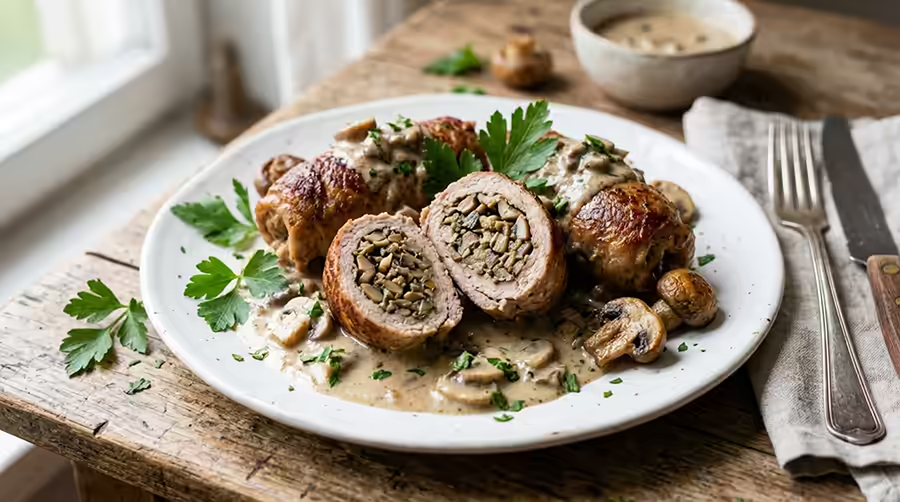
Why mushrooms are better to pre-sauté, to absorb moisture.
Fresh mushrooms contain a lot of water. If you cook them with the base, during cooking all the moisture will come out — the meat will become mushy, the roulade will fall apart and separate.
So mushrooms should always be sautéed before using them in the base. Ideally, chop them finely, sauté them dry or with a little oil to evaporate moisture. Alternatively, you can add onions — they complement the mushroom flavor well. The base should be kept dry and slightly undercooked, without visible moisture on the bottom.
Forest mushrooms (if you use dried ones) should be soaked in warm water, then they will give off flavor. The taste will be more intense than in the canned ones.
Do you pair mushrooms with cheese or sour cream?
There are various options for work.
Mushrooms + creamy cheese — a classic combination. The cheese stands out as a binding element: the base retains form and does not dissolve when heated.
Mushrooms + smoked cheese — a lower variant, but requires caution. If you add smoked cheese directly to the base, take little of it—literally 1–2 tablespoons—and it’s thick slices. Otherwise, the base will become rare again.
The easiest and most reliable option for beginners—mushrooms with cheese without smoked flavor in the base. The smoked one does indeed lead to a sauce.
Little crispy pieces with black bread
What meat best pairs with black bread
The most common option is pork. Black bread has a sweet-sour taste that wonderfully complements fatty pork and provides weight. The balance comes out fried, a bit of sweetness from the black bread—this is what you want.
With courgette, black bread pairs too, but the taste will be softer and less pronounced. If you want a distinct contrast—take the pork.
Yellow courgette with black bread—more complex option: combines cheese and yellow courgette requires additional cooking, so this tandem is better left for those who are already well-oriented in the recipe.
Do you want to add nuts, cheese or toppings
Nuts—yes, and it’s a great idea. Walnut nuts pair well with black bread naturally: a light bitterness of the nuts + sweetness of the black bread = deep taste. Chop the nuts finely, so they don’t overwhelm the base.
Cheese for the black bread base—is a neutral option. If you want the base to be thicker, add some crumbled hard cheese.
Toppings—goes better in the sauce, less in the base. Base sauce to the little pieces from black bread gives less, yielding a slight sweetness that enhances the flavor of the base.
Little pieces in the filling
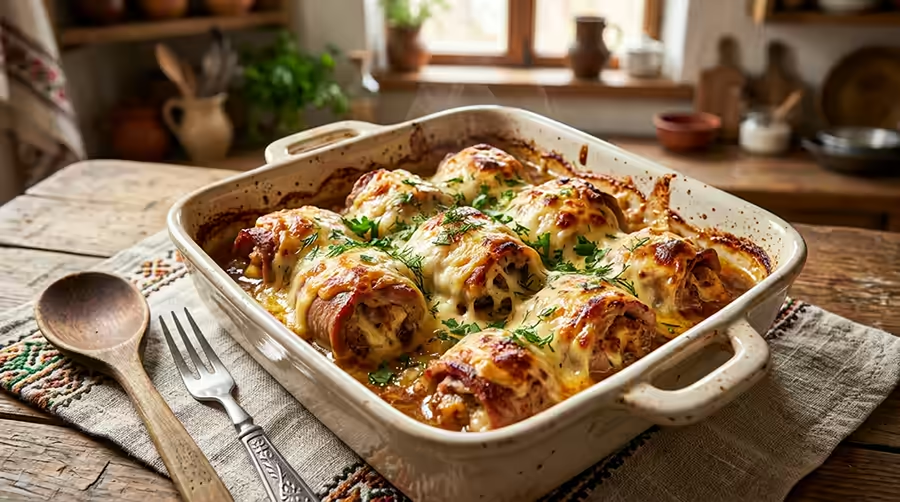
Sauce for the sweetness: smoked, toppings, white or their mixture
Sauce in the filling—not just an addition, but a condition for sweetness. Without sufficient quantity of cheese, pieces crumble and become dry.
The most common variants:
- Meat + broth — balanced, good for cooking pork and chicken. Proportion: 3–4 tbsp. of meat per 100 ml of broth.
- Top parts — lower sauce, ice cold. Top parts 20–30% fat add directly in the form — 150–200 ml per one portion of the dish.
- Broth + onion — a simple variant without milk. The onion during the roasting releases and enhances the sauce.
- Mixed: meat + top parts + broth — the richest in flavor. Suitable for festive occasions.
The main rule: the sauce should cover the skewers tightly on the third or on the napkin. If the meat is thin — remove the three quarters of the broth right before roasting.
Time and temperature
Specific numbers depend on the type of meat, the amount of sauce, and the specifics of your seasoning. As a result, cooking with different types of meat:
- Pork at 180°C in the form with a lid or foil — originally 30–40 minutes, then another 10 minutes without the lid for crispiness.
- Chicken at 180°C — cooks faster: originally 20–25 minutes under foil.
- If you want more roasted — raise the temperature to 200°C in the last 10 minutes and remove the foil.
Check the readiness, piercing the thickest part: the juice should be clear.
Tips
The skewers should be the same length, so that the meat doesn’t unroll.
The golden rule — don’t overcrowd, keep it in one layer. The start should not be tight, stick to the edges or pin the skewer in between. A thin even layer, a gap from the edge — and the skillet closes normally.
If the start is already a lot, the overlapping piece tears or the rolled-out will exit over the width and uneven. Better to make two accurate skewers than one overstuffed bunch.
Practical orientation: 1.5–2 tbsp. of start per one piece of pork of medium size — this is usually enough.
How to remove the thread or toothpick
Before serving—always. The meat or the cheese should be removed after the dish is ready and the cooking time (5 minutes) has passed. If the meat is removed after the fire is out, the roll may partially unravel—my meat is still not “dehydrated.”
Tip: count the pieces the teeth to the beginning and after the end. If in the tray there are less than it is left in the roller. It’s not scary, but it’s better to check afterwards.
Typical tags
Always heavy meat
If the layer of tart crust is more than 1 cm, its filling should be leveled—the roller comes out unevenly, it does not slide in the center and looks unsightly. Reflect to a thickness of 5-7 mm. A layer or a package during reflection—do not stick, and the filling: the meat does not tear and does not crumble.
Add moisture start
This is the most common reason why rolls fall apart. Mushrooms—cover. Cheese—take hard, not melted—cream. Black mushrooms—if they have heavy meat or in cheese, cover with paper towels before laying.
Insufficient sauce while braising or glazing
Rolls—do not stain, do not smear “nashukhu”. If the layer is small, they just peel off. In the skull, the sauce must cover the roller almost on the third. In the spirits—it’s the same. If in a median preparation you see that the layer of lifting is out—boldlyremove from the fire, respectively heavy.
Recipe variations
From cheese
The simplest and quickest start. The hard cheese, garlic, greens—and that’s it. Good suits for busy days when you want something homemade without unnecessary fuss. Sauce—a classic seasoned.
With mushrooms
Covered with forest mushrooms or forest mushrooms with cebule. Scented, aromatic. Mushrooms might cover afterwards— for example, in the evening, so that the morning can be easily collected and prepared.
With black mushrooms
Sour-sweet start, which especially stands out with pork. Black mushroom is better to take without skin. Nuts as desired. The dish with the characteristic—suits for Sunday lunch or guests.
With mushrooms and cheese
A combination of two starters: stuffed mushrooms + tart lemongrass. The cheese provides a binding element and gives a topping note. One of the most popular variations – it’s tasty, simple, and reliably keeps its form.
With black garlic and peppers
The biggest ‘festive’ variation among all mentioned. Detailed black garlic + hairy peppers – the starter is silky, aromatic, with distinctive character. It pairs well with pork and the topping sauce.
How to serve
How to serve the main hot dish
Stuffed mushrooms – a savory meat dish that requires garnish. The most common variations: potato puree, boiled or baked potatoes, buckwheat, rice. All of them are well complemented by sauce.
Serve hot. Before serving on the plate – remove the toothpick or skewer. Drizzle sauce on top and sprinkle with fresh herbs.
For a festive table
On a holiday, stuffed mushrooms look good on a portioned serving: two mushroom caps on the plate, sauce on the side or on top, decorated with greenery or thin slices of pickled vegetables.
If preparing in advance – store the stuffed mushrooms in sauce, and before serving, warm them in the same sauce on low heat. This way they stay succulent and won’t dry out.
How to store
In the refrigerator
Prepared stuffed mushrooms are stored in the refrigerator in a sealed container or in form, wrapped in a food film. It’s better to store them with sauce – it protects the meat from drying out. Under such conditions, the dish keeps for 2–3 days.
Before storing, cool the dish to room temperature – do not place hot in the refrigerator.
How to defrost to avoid overheating
The best way – on a skewer or in a casserole over low heat under a lid. If the sauce thickens or you have leftover sauce – add a few tablespoons of broth or water. Heat gently, without bringing to a boil.
In a microwave it’s also possible, but cover the plate with a lid or special cover – this retains moisture and prevents drying out. Power – medium, time – 2–3 minutes depending on the quantity.
Preheat to 160°C, cover with foil, 15-20 minutes. Adjust if you need to cook a larger portion.
FAQ
Is it possible to cook without covering?
Yes, it is possible. If you place the cheese curds in the sauce and cover them with a lid or bake them in a form with a lid — it will still turn out tasty. However, without covering there won’t be a golden crust, and the roulades might take longer to achieve the form. If you want a quick version without dirty dishes — just place in the sauce without covering.
What can replace the culinary thread?
Clips are the easiest option. You can also use thin wooden skewers (break to the required length) or regular cheeses without a cheesecloth (previously break and select only wooden parts). The main thing — the filling must be safe for her and can be well maintained.
What starting cheese best maintains shape?
Hard and dry. The most reliable options: pressed hard cheese (it sticks to the filling), covered and dehydrated mushrooms, cheese mixture with mushrooms. The most problematic: fresh mushrooms without previous cover, very soft melted cheese, starts with a large share of the family.
If the starter forms the difficulty — add some shredded tergo cheese or molds. They absorb moisture and provide a necessary consistency.