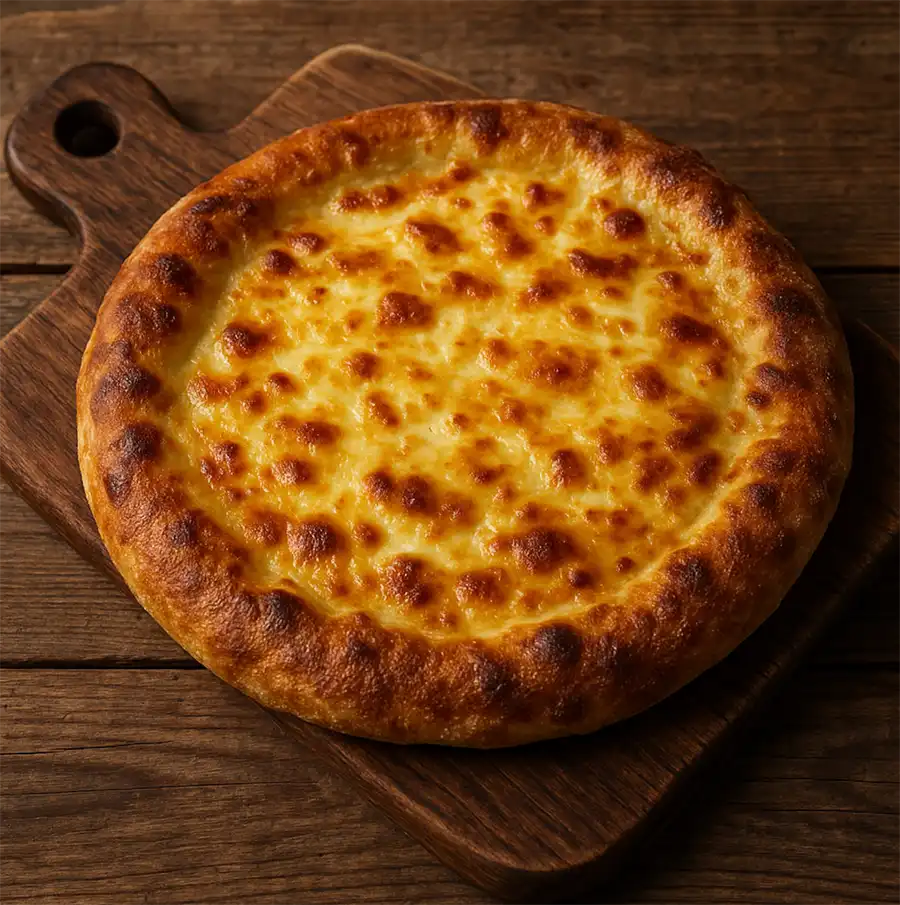
Why exactly Megrelian khachapuri?
Megrelian khachapuri (megruli) is a Georgian flatbread with cheese inside and an additional layer of grated cheese on top. It is the double cheese that makes the Megrelian version especially juicy, with an intense cheese aroma and a luxurious stringy texture. Unlike Imeretian khachapuri, where the cheese is only inside, the Megrelian version looks golden and has an appetizing cheese cap that browns in the oven.
The ideal Megrelian khachapuri is tender, well-risen dough with a light creamy taste, a generous but balanced amount of cheese, the right moisture content in the filling, and short baking at a high temperature to preserve juiciness.
Content
Briefly about the recipe for Megrelian khachapuri
- Servings: 6–8
- Time: 20 minutes of active work + 60–90 minutes for the dough + 12–15 minutes of baking
- Difficulty: medium
- Baking format: stone/steel/baking tray in an oven at 240–260°C or cast iron pan + oven
Inventory
- Kitchen scales
- Large bowl for dough
- Flour sieve
- Spatula/fork, rolling pin
- Cheese grater (medium and large attachments)
- Baking tray or pizza stone/steel
- Baking paper or fine semolina/flour for dusting
- Pastry brush
Ingredients (classic, 28–30 cm)
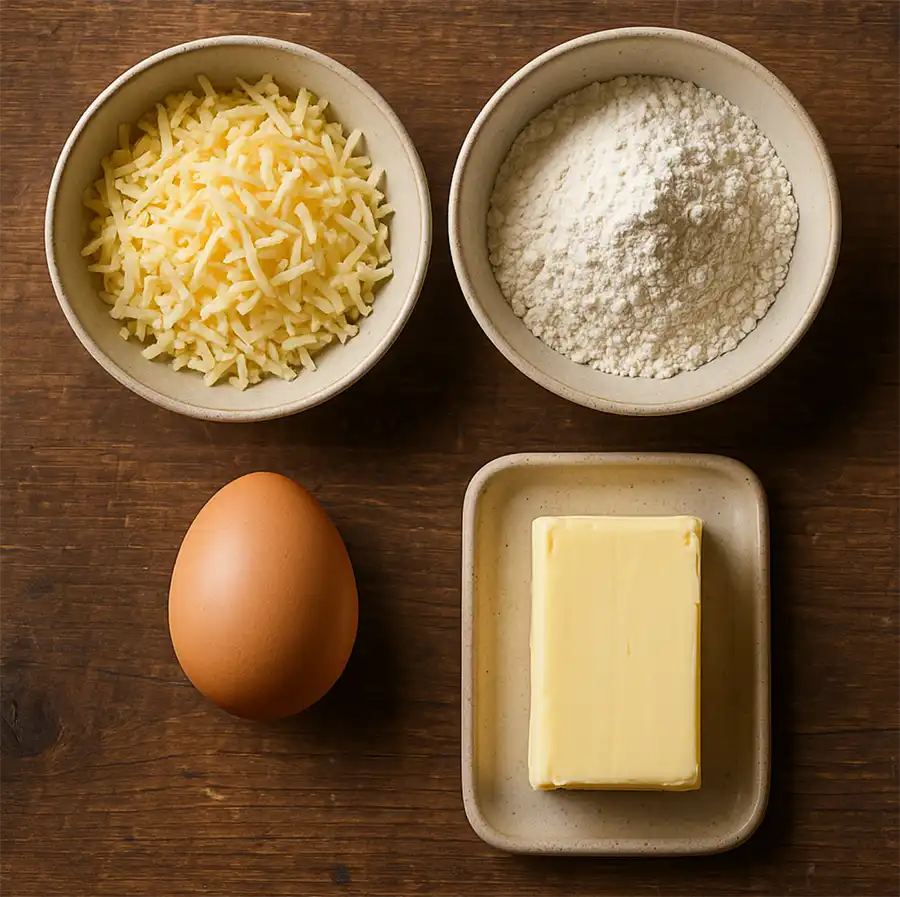
- Wheat flour — 500 g (plus 30–50 g for dusting)
- Water or milk at 35–38°C — 250 ml
- Dry yeast — 7 g or fresh yeast — 20 g
- Oil or melted butter — 30 g
- Salt — 8–10 g
- Sugar — 8–10 g
- Egg — 1 (optional, for the dough)
- Suluguni cheese — 400–500 g
- Imeretian cheese/soft brynza/mozzarella — 200–300 g
- Yogurt/mazoni/sour cream 10–15% — 1–2 tablespoons (for juiciness of the filling, optional)
- Egg for greasing — 1 piece
- Butter for the finished product — 20–30 g
Note on cheeses: traditionally, a mixture of suluguni and Imeretian cheese is used. In Ukraine, suluguni is often mixed with young brynza (soaked to remove salt) or mozzarella (for stretchiness) in a 2:1 ratio.
Cheese selection and preparation
The main sign of a successful megrul is cheesy stickiness and moderate moisture. Cheese that is too wet will run, soak the dough, and destroy the structure. Cheese that is too dry will make it crumbly and overly salty.
- Recommended combination: suluguni 60–70% + soft cheese 30–40%.
- If the cheese is salty, soak it in cold water for 30–60 minutes, changing the water once.
- Grate: medium grater for the filling, large grater for the top layer.
- Moisture: if the cheese is wet, gently squeeze it in cheesecloth and add 1 teaspoon of starch or 1 tablespoon of grated hard cheese to stabilize it.
- Aromatics: for the classic version, a pure cheese flavor is sufficient. A pinch of black pepper or 1–2 tablespoons of matsoni for creaminess work delicately.
Dough: 3 working approaches
1) Classic yeast (warm method)
- Hydration 50%: for 500 g of flour — 250 ml of liquid.
- Liquid temperature: 35–38°C to activate the yeast.
- Knead until smooth and elastic, with a “window” in the film.
- First fermentation: 60–75 minutes at 26–28°C until doubled in size.
- Short break, 10 minutes rest.
Pros: most authentic taste, good crumb structure, aroma. Cons: time-consuming.
2) Quick yeast-free (with kefir/yogurt)
- 500 g flour, 300 ml kefir/yogurt, 1 teaspoon baking soda, 1 teaspoon salt, 30 g oil.
- Rest for 15 minutes after mixing to allow for hydration.
- The texture is denser, but it gives good results in 45–60 minutes.
Pros: fast, consistent. Cons: less bread aroma, different crust.
3) Cold fermentation (12–24 hours)
- Knead dough with 60% hydration (300 ml of liquid per 500 g of flour) and 0.3% yeast (1.5 g dry).
- In the refrigerator for 12–24 hours, then heated for 60 minutes.
- Provides a deep flavor profile, elasticity, and easier rolling.
Pros: intense flavor, plasticity. Cons: time planning.
Step-by-step recipe for Megrelian khachapuri (classic yeast)
1) Activate the yeast. Add sugar and yeast to warm water/milk, stir, and leave for 10 minutes until it forms a cap.
2) Combine the dry ingredients. Sift the flour, add salt, and mix.
3) Kneading. Pour in the activated yeast, add the egg (optional) and oil/butter. Knead for 8–10 minutes until smooth. The dough should be soft, slightly sticky, but hold its shape.
4) First fermentation. Transfer to a greased bowl, cover, and place in a warm place for 60–75 minutes until doubled in size.
5) Filling. While the dough is rising, grate the cheese. Mix the main part (everything except 80–100 g, which will go on top). If necessary, add 1–2 tablespoons of matsoni.
6) Kneading. Knead the dough, form a ball, and let it rest for 10 minutes.
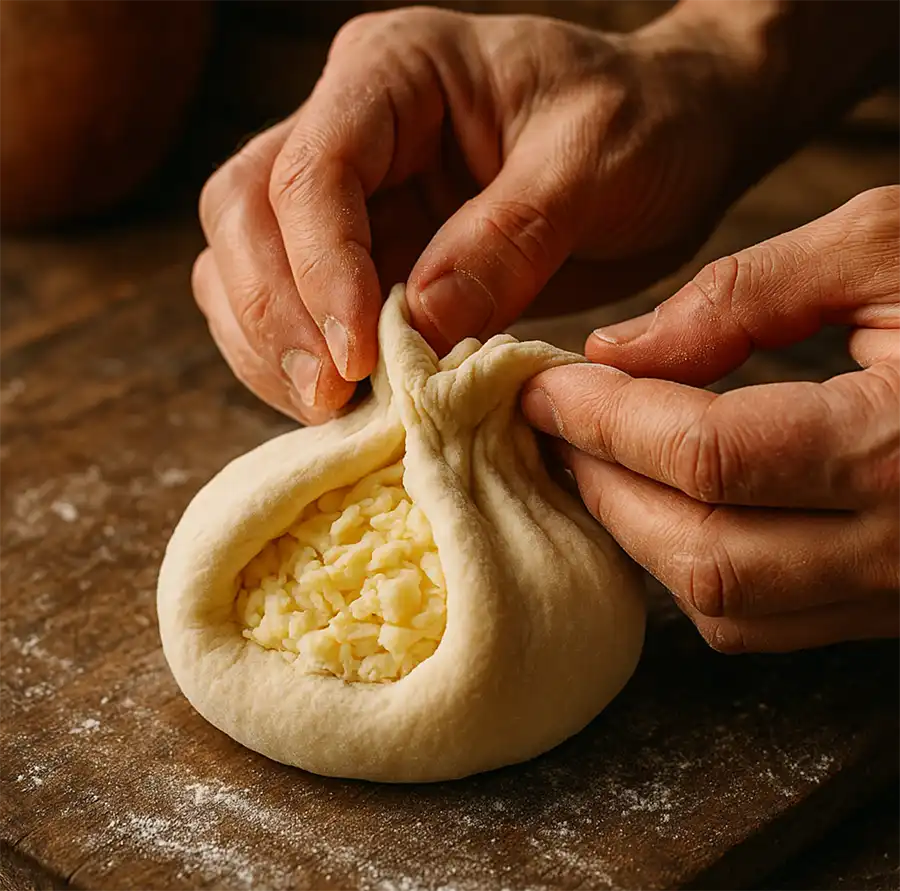
7) Forming a cake with a “knot.” Roll out a circle Ø 22–24 cm, place 2/3 of the cheese filling in the center. Gather the edges toward the center, forming a pouch. Pinch tightly, turn the seam down.
8) Rolling out. Carefully roll out to Ø 28–30 cm. Thickness 8–10 mm in the center, 12–15 mm at the edge. Do not press too hard to avoid tearing the dough.
9) Steam vent. Make a small hole or several punctures in the center to allow steam to escape.
10) Brush with egg wash and sprinkle with cheese. Mix the egg with 1 teaspoon of milk/water and brush the surface. Sprinkle the reserved 80–100 g of grated cheese evenly over the top.
11) Baking. Transfer to a preheated stone/steel/baking sheet. Bake at 240–260°C for 10–14 minutes until the crust is golden brown and the top layer is melted. Check after 9–10 minutes.
12) Finishing touches. Remove from the oven and immediately brush with butter. Allow to stabilize for 3–4 minutes, cut into wedges, and serve hot.
Temperature and time
- Optimal temperature: 250°C (top-bottom) or 240°C with convection.
- If your oven is weak, preheat the baking sheet for at least 25–30 minutes; increase the baking time by 2–3 minutes.
- Khachapuri bakes faster and rises more evenly on stone/steel.
Alternative ways to prepare Megrelian khachapuri
- Cast iron skillet + oven: preheat the skillet for 15 minutes in the oven, transfer the khachapuri to the hot surface, bake for 8–10 minutes on maximum heat.
- Frying pan on the stove + oven grill: 3–4 minutes on medium heat until lightly browned on the bottom, then 6–8 minutes under the grill at 230–240°C.
- Air fryer: 200–205°C, 8–10 minutes; shape into a slightly smaller diameter (24–26 cm).
- Electric grill/pizza maker: 7–9 minutes at 300–350°C, with top layer control.
Dough options
- With milk: softer and more aromatic, browns faster.
- In water: neutral taste, better structure retention, suitable for saltier cheeses.
- With a semolina content of 10–15%: slightly crispy around the edges.
- With butter: softer crumb, caramelized crust.
- With yogurt/matsoni in the dough 5–10%: softness and slight sourness.
Options for Megrelian khachapuri fillings
- Classic mix: suluguni + Imeretian.
- Ukrainian equivalents: suluguni + young rassolny cheese; suluguni + mozzarella; suluguni + unsalted brynza; suluguni + homemade sour milk cheese (well pressed).
- With herbs: finely chopped cilantro or green onions, 1–2 tablespoons to the filling.
- Spicy accent: 0.5 tsp ground adjika or chili flakes in the middle.
- With smoked suluguni: 20–30% of the weight gives a light smokiness, but does not overwhelm the classic character.
Size, shape, and portioning
- Diameter 28–30 cm — family size for 6–8 servings.
- Diameter 22–24 cm — for 3–4 servings.
- Mini format Ø 12–14 cm — individual portions, convenient for freezing and food cost.
Serving and side dishes
- Serve immediately to preserve the texture.
- A drop of melted butter on top and lightly rubbing garlic on the rim — a restaurant touch.
- Sauces: matsoni with salt and dill, mild adjika, tkemali.
- Accompaniment: light salad with tomatoes and green onions, pickled onions, ayran/chakhokhbili as a side dish.
Common mistakes and how to avoid them
- The dough tears when rolling. Cause: insufficient rest of gluten or rolling too thinly. Solution: let rest for 10 minutes, roll from the center to the edge.
- The filling leaks out. Reason: wet cheese or excess matsoni. Solution: squeeze the cheese, add a pinch of starch or hard cheese.
- The bottom is raw, the top is overcooked. Reason: cold baking sheet. Solution: preheat the stone/steel/baking sheet for at least 25 minutes.
- Bland taste. Cause: insufficiently salted filling or dough. Solution: balance the salt in the dough (1.8–2% of the flour) and control the saltiness of the cheese.
- The crumbs are too dense. Cause: under-risen dough or too stiff kneading. Solution: wait until the volume doubles, monitor the softness of the dough.
Secrets that enhance the result of Megrelian khachapuri
- Stone or steel in the oven changes the game: the initial heat gives rise and a crispy bottom.
- Fine semolina instead of flour for dusting — less burning and a better slippery start.
- A small hole in the center stabilizes the steam and prevents blisters.
- The layer of cheese on top should not be thick; 80–100 g is enough for 28–30 cm; any excess will spill over.
- After baking, the oil retains moisture and adds shine.
- Cold fermentation is the most delicious profile, if time allows.
- For the perfect photo: lightly brush the cake with melted butter and let it “rest” for 2–3 minutes before cutting so that the cheese stabilizes a little.
Storage and reheating
- Room temperature: up to 6 hours, covered with a towel.
- Refrigerator: up to 48 hours in an airtight container.
- Freezing: raw shaped khachapuri (without egg and without cheese on top) — up to 2 months; bake from frozen at 220–230°C for 3–5 minutes longer and add cheese on top halfway through.
- Heating: oven/air fryer 180–190°C for 6–8 minutes; frying pan under a lid on low heat for 5–6 minutes. Microwave is not recommended — it loses its crispiness.
Nutritional value (approximately 1/8 of the product, Ø 30 cm)
- Calorie content: 320–380 kcal
- Protein: 14–18 g
- Fats: 16–20 g
- Carbohydrates: 28–34 g
The indicators vary depending on the composition of the cheese and the type of fat in the dough.
Adaptations for dietary needs
- Fewer calories: replace some of the suluguni cheese with low-fat soft cheese (10–15%) and reduce the butter by 30%.
- Lactose-free: use lactose-free cheeses with good stretch; mix 70/30 and add 1 tsp of starch.
- Vegetarian rennet: check cheese labels and choose options with microbial enzymes.
- Pseudo-gluten-free version: using a mixture of rice/corn flour with xanthan gum will result in a different texture; it is better to prepare it as a cheese “galette” using a gluten-free mixture with an additional egg for binding.
Detailed cheese substitutions in Ukraine
- Suluguni: stretchy texture, medium saltiness, melts evenly.
- Imeretinsky: delicate, slightly sour; substitute — young soft brined cheese.
- Brynza: use desalted; adds saltiness and a distinctive flavor, mix 1:2 with suluguni.
- Mozzarella: adds stretchiness but is neutral in taste; add 30–40% to suluguni.
- Hard cheese (such as young Gouda): 10–15% in the filling for moisture stability.
Professional timing for food service
- Miz-an-plais cheese: grate and keep separately “inside” and “on top” so that the top is drier.
- Pre-heating: 220°C, 3–4 minutes, finishing oil in the hall.
- Weight control: dough for 30 cm — 280–320 g; filling 450–550 g in total.
Frequently Asked Questions
- What is the difference between Imeretian and Megrelian khachapuri?
Megrelian khachapuri has cheese not only inside, but also on top, so the taste is more intense and creamy. - Is it necessary to make a hole in the center?
It is recommended. It allows steam to escape, reducing the risk of blisters and tearing. - What is the ideal baking temperature for Megrelian khachapuri?
At home, 240–260°C on a preheated stone/steel or baking sheet. - Is it possible to make Megrelian khachapuri without yeast?
Yes, using kefir/yogurt with baking soda. The texture will be different, but the result will be satisfactory. - Why is the cheese leaking?
Excess moisture in the cheese or a thin bottom. Press the cheese, add a pinch of starch, and check the thickness. - What kind of flour should you use? High-grade
wheat flour with an average protein content of 10.5–11.5% is optimal for elasticity. - Is an egg necessary for the dough?
Not necessarily. It adds color and slightly enriches the dough. - What should you brush the top with?
Traditionally, egg; you can add a little milk or matsoni for shine. - How much cheese should be placed on top of a Megrelian khachapuri?
For a 28–30 cm khachapuri, 80–100 g is sufficient so as not to overload it and cause leakage. - Is hard cheese suitable?
In small quantities (10–15%) to stabilize moisture content — yes. As a base — no, because it is less stretchy. - Can Megrelian khachapuri be frozen?
Yes. It is best to freeze raw khachapuri without eggs and cheese on top. - How to get a crispy bottom?
Preheat the stone/steel/baking sheet for at least 25 minutes; sprinkle with fine semolina. - Why is the dough dense?
Insufficient fermentation or stiff kneading. Allow it to rise fully, test with the “fingerprint” test. - What is the optimal diameter?
28–30 cm is universal for a family; 22–24 cm is for smaller portions or an air fryer. - Should you add butter to the filling?
Usually not, as there is enough fat in the cheese. Butter is the finishing touch to a hot dish. - Should you add more salt to the dough if the cheese is unsalted?
Yes, balance it out: up to 2% salt by weight of flour, but don’t overdo it. - What can replace suluguni?
A combination of mozzarella (for stretchiness) and young brined cheese (for flavor), plus a pinch of hard cheese. - Is lactose-free cheese suitable?
Yes, if it melts well; check the stretchiness on a small sample. - How to cut it so that the cheese doesn’t leak out?
Allow 2–3 minutes for it to stabilize after removing it from the oven, then cut with a sharp knife. - How to make the edges of Megrelian khachapuri softer?
Add 5–10% yogurt to the dough, reduce baking time by 1 minute, and immediately brush with butter. - Why is the top burning?
Too close to the grill or too much egg in the glaze. Move it lower, dilute the egg with milk. - Can you make it without the egg on top?
Yes. Brush with milk or yogurt for color, or bake without anything — the cheese on top will melt. - Are spices appropriate in Megrelian khachapuri?
The classic version uses a minimum of spices. Black pepper or a pinch of utskho-suneli work delicately. - How to present it nicely for photos?
Cut it into 6–8 pieces, melt some butter on the side, add a few cilantro leaves and some textured cheese crumbs on the board.
Quality control at every stage
- Kneading: the dough should be smooth, soft, and not tear when stretched lightly.
- Fermentation: 2 times increase, porous structure inside.
- Rolling: uniform thickness, no exposed cheese.
- Filling: moist but not wet; holds its shape in the “bag.”
- Baking: golden top, melted cheese, springy center, crispy bottom.
Recipe for “quick evening” (with kefir)
- 500 g flour, 300 ml kefir, 1 tsp baking soda, 1 tsp salt, 30 g oil.
- Knead, let rest for 15 minutes.
- Shape, fill with cheese, brush with butter, and bake at 230–240°C for 12–14 minutes.
- The texture is denser, but it’s a great compromise for everyday use.
Calculation for two units (café/at home for a group)
- Double the ingredients, divide the dough after the first rise into two balls weighing 300–320 g each.
- Work in turns: while the first is in the oven, the second matures on the table for 10 minutes, which gives it better plasticity.
A quick checklist before baking
- The baking sheet/stone is well heated.
- The cheese is pressed, the top layer is dry.
- The dough has rested and can be rolled out without tearing.
- There is a hole in the center for steam.
- The egg is diluted with 1 teaspoon of milk for an even shine.
Final advice
Maintain a balance between the moisture content of the filling, the temperature, and the baking time. Proceed in small steps: if the cheese is runny, press down harder and heat the surface better; if it is dry, add a little matzo to the filling and reduce the baking time by 1 minute. After two or three attempts, you will consistently get spectacular, stretchy, and aromatic megrul, worthy of the cover of a culinary blog.