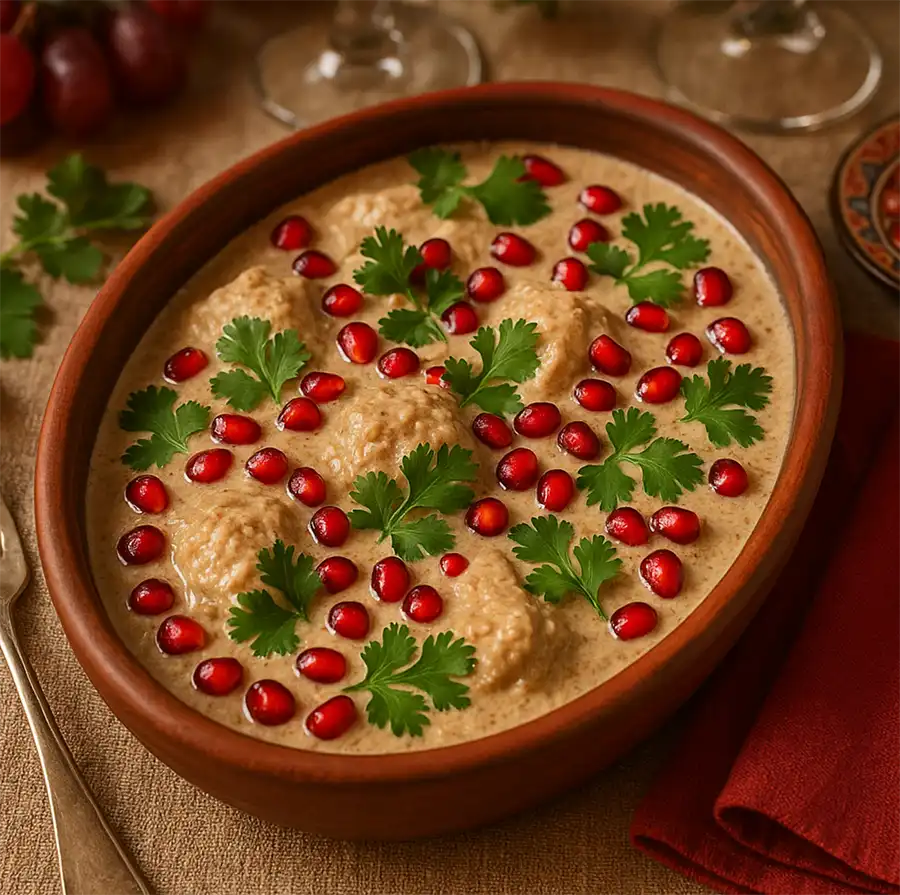
Satsivi is a true gem of Georgian cuisine, combining centuries-old traditions and unique flavors. This cold dish of tender poultry meat served with a fragrant nut sauce has long won the hearts of gourmets far beyond the Caucasus and has become an essential part of any festive table.
What is satsivi: definition and characteristics
Satsivi (Georgian: საცივი) literally translates as “cold dish” and is a unique combination of two components: tender poultry meat and a thick, aromatic walnut sauce. It is important to understand that satsivi is not just a sauce, but a complete dish, where the sauce and meat create a harmonious unity.
Main characteristics of satsivi:
- Served exclusively cold
- Has a thick consistency thanks to walnuts
- Contains a rich bouquet of Georgian spices
- Traditionally prepared for festive occasions
History and traditions of preparation
Satsivi has deep roots in Georgian culinary tradition and is inextricably linked to the most important holidays. This dish is an essential part of New Year’s and Christmas feasts in Georgia, symbolizing hospitality and the continuation of family traditions.
Traditionally, satsivi was made with turkey, as this bird was considered the most suitable for festive occasions. However, over time, the recipe has been adapted to local conditions, and today the most common version is satsivi made with chicken.
Classic recipe for chicken satsivi
Ingredients:
For the main meat:
- Chicken (whole or parts) – 1.5-2 kg
- Water – 2.5-3 liters
- Carrot – 1 piece.
- Onion – 1 piece.
- Bay leaf – 2-3 pieces.
- Black peppercorns – 5-6 pieces.
- Salt – to taste
For the nut sauce:
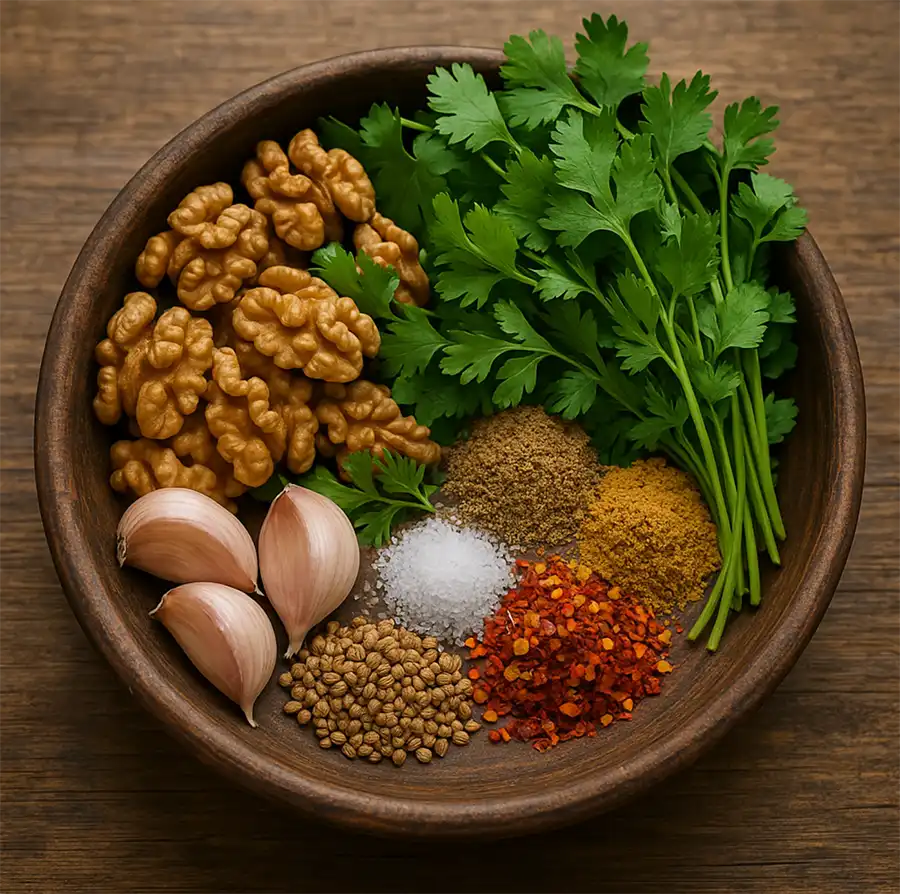
- Walnuts (kernels) – 300-400 g
- Garlic – 1 head (6-8 cloves)
- Fresh cilantro – 1 large bunch
- Hops-suneli – 1 tablespoon
- Utsho-suneli – 1 tsp.
- Imeretian saffron – ½ teaspoon
- Ground coriander – ½ teaspoon
- Red hot pepper – ¼ teaspoon
- Ground cinnamon – ¼ teaspoon
- Ground cloves – a pinch
- Wine or apple cider vinegar – 2 tablespoons
- Salt – to taste
Step-by-step preparation process:
Step 1: Preparing the meat
- Cooking the broth: Place the chicken in a large pot, cover with cold water, and bring to a boil. Be sure to skim off the foam to obtain a clear broth.
- Adding flavorings: Place whole peeled onions, carrots, bay leaves, and peppercorns in a pot. Cook the chicken for 40-50 minutes until done.
- Baking for a crispy crust: Remove the cooked chicken from the broth and bake in the oven at 200°C for 15-20 minutes to obtain a golden crust.
Step 2: Preparing the nut sauce
- Processing nuts: Pass walnuts through a meat grinder twice or grind them in a blender until they become a paste. It is important to obtain a homogeneous mass without large pieces.
- Prepare the herbs and spices: Finely chop the cilantro, mince the garlic, or press it through a garlic press. Mix all the spices in a separate bowl.
- Making the sauce base: In a large bowl, combine the chopped nuts, garlic, cilantro, and all the spices. Gradually add the warm chicken broth, stirring constantly until the consistency of thick sour cream.
Step 3: Finishing the preparation
- Assembling the components: Cut the chicken into portions and place in a saucepan with the nut sauce.
- Heat treatment: Place the pot on low heat, bring to a boil, and cook for 15-20 minutes, stirring constantly.
- Vinegar dressing: At the end of cooking, add wine vinegar and boil for another 2-3 minutes.
- Cooling: Remove the satsivi from the heat and leave to cool at room temperature, then place in the refrigerator for at least 4 hours.
Variations of satsivi with different types of meat
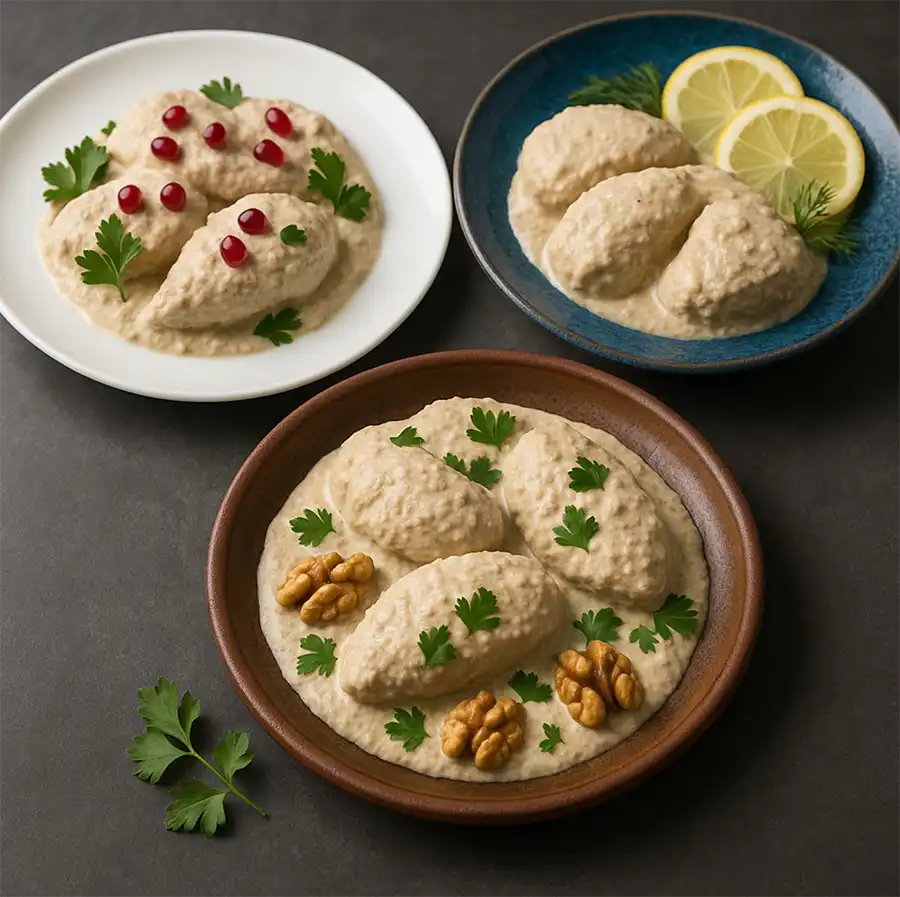
Turkey satsivi
The traditional option, considered the most authentic. Turkey gives the dish a special tenderness and delicate flavor:
Cooking features:
- Cooking time increases to 1.5-2 hours depending on the size of the bird.
- More spices are used due to the larger volume of meat.
- The sauce is prepared using a richer broth.
Fish satsivi
Less common, but traditional for coastal regions of Georgia:
Recommended fish species:
- Zander
- Trout
- Salmon
- Cow
Features:
- Cooking time is significantly shorter (20-30 minutes)
- Add more lemon juice or vinegar
- More delicate spices are used
Satsivi made from duck or goose
For those who prefer a richer flavor:
Preparation:
- Mandatory removal of excess fat
- Longer cooking time (1.5-2 hours)
- Use of aromatic herbs (thyme, rosemary)
Secrets and tips from Georgian chefs
Selecting and preparing nuts
Criteria for high-quality walnuts:
- Light-colored kernels without dark spots
- Absence of bitterness
- Freshness (no more than one year from the date of harvest)
- Nuclear integrity
Expert recommendations:
- Roast the nuts in a dry frying pan for 2-3 minutes to release their aroma.
- Use only kernels that have been cleaned of film
- Grind the nuts immediately before cooking.
Working with spices
The main Georgian spices for satsivi:
| Spice | Purpose | Quantity |
|---|---|---|
| Suneli hops | Main aroma | 1 tbsp |
| Utsho-suneli | Spiciness and pungency | 1 tsp |
| Imeretian saffron | Color and aroma | ½ tsp |
| Coriander | Citrus notes | ½ tsp |
| Cinnamon | Warmth and sweetness | ¼ tsp |
Tips for use:
- Add spices gradually, tasting constantly.
- Imeretian saffron can be replaced with regular saffron, but in smaller quantities.
- Fresh cilantro is a must—without it, the flavor will be incomplete.
Achieving the right consistency
The ideal consistency of satsivi:
- The sauce should coat the pieces of meat thoroughly.
- When cooled, the mixture thickens slightly.
- There should be no separation into oil and solid parts.
Correction methods:
- If the sauce is too thin, add more chopped nuts.
- If it is too thick, gradually add warm broth.
- For extra thickening, use 1 tablespoon of flour.
Common mistakes and how to avoid them
Mistakes when cooking broth
What not to do:
- Use vigorous boiling – the broth will become cloudy.
- Leaving foam will impair the taste and appearance.
- Overcooking meat will make it tough and stringy.
Mistakes in working with nuts
Common problems:
- Using old or rancid nuts
- Insufficient grinding – the sauce will be coarse
- Excessive grinding to an oily state
Mistakes in adding spices
What can spoil the taste:
- Excess of hot pepper
- Insufficient amount of cilantro
- Adding vinegar at the beginning of cooking instead of at the end
Contemporary variations and experiments
Lazy satsivi
A simplified version for modern housewives:
Ingredients:
- Ready-cooked chicken – 1 kg
- Walnuts – 200 g
- Garlic – 3 cloves
- Cilantro – a bunch
- Homemade mayonnaise – 3 tablespoons
- Salt to taste
Preparation: Mix
all ingredients, season with mayonnaise, and chill.
Vegetarian satsivi
For those who do not consume meat:
Base options:
- Baked eggplant
- Cauliflower
- Mushrooms (button mushrooms, champignons)
- Tofu
Satsivi with seafood
Modern interpretation using:
- Shrimp
- Squid
- Mussel
- Crab meat
Serving and presentation
Traditional serving
Classic rules:
- Serve only cold.
- Garnish with pomegranate seeds and fresh cilantro.
- Serve on a large platter for shared consumption.
- Serve with Georgian bread or lavash
Modern table setting
Serving options:
- Individual portions in deep plates
- Canapés for the festive table
- As part of a Georgian feast, alongside khachapuri and khinkali
Drinks to accompany satsivi
Traditional combinations:
- Red dry Georgian wine (Saperavi, Cabernet)
- White semi-dry wine (Rkatsiteli)
- Borjomi mineral water
Storage and shelf life
Storage rules
Optimal conditions:
- Temperature: +2°C to +6°C
- Container: tightly sealed glass or plastic container
- Shelf life: up to 5 days in the refrigerator
Important to know:
- Do not leave satsivi at room temperature for more than 2 hours.
- Remove from the refrigerator 20-30 minutes before serving.
- Do not freeze – this will ruin the texture of the sauce.
Signs of spoilage
When not to use:
- The appearance of an unpleasant odor
- Separation of sauce with liquid separation
- Change in meat color
- Sour taste
Useful properties and calorie content
Nutritional value
Per 100 g of product:
- Calories: 220-250 kcal
- Protein: 18-20 g
- Fat: 15-18 g
- Carbohydrates: 6-8 g
The beneficial properties of walnuts
For heart health:
- Omega-3 fatty acids
- Lowering cholesterol levels
- Improved blood circulation
For the nervous system:
- B vitamins
- Magnesium and potassium
- Improved memory and concentration
For immunity:
- Vitamin E
- Zinc and selenium
- Antioxidant properties
Frequently asked questions about satsivi
Can satsivi be prepared in advance?
Yes, it is even better to prepare satsivi a day before serving. During this time, the flavors blend better, and the sauce acquires the desired consistency.
What can replace Imeretian saffron?
You can use regular saffron (half the amount), turmeric for color, or calendula.
Why does satsivi separate?
The most common causes:
- Adding broth too quickly
- Using hot broth instead of warm broth
- Insufficient stirring during preparation
Can you prepare satsivi without cilantro?
Cilantro is a must-have ingredient, but if you don’t have any, you can substitute parsley with a little basil.
How long does it take to cool down?
At least 4 hours in the refrigerator, but it is better to leave it overnight. Complete cooling is important for forming the correct texture.
Can satsivi be frozen?
Freezing is not recommended, as the sauce may separate after thawing and the texture of the meat will deteriorate.
How to properly reheat satsivi?
Satsivi is not heated—it is a cold dish. Simply remove it from the refrigerator 20-30 minutes before serving so that it reaches room temperature.
Satsivi in the modern world
Today, satsivi has spread far beyond Georgia and has become popular in many countries around the world. This dish is ideal for festive meals, picnics, and as an original appetizer for guests.
The advantages of satsivi in modern cuisine:
- Can be prepared in advance
- No heating required
- Rich in nutrients
- Has an unusual and memorable taste
- Suitable for special occasions
Georgian satsivi is not just a dish, but a true cultural code that conveys the centuries-old traditions of hospitality and culinary mastery of the Caucasian peoples. Once you try this unique combination of tender meat and aromatic nut sauce with a bouquet of Georgian spices, you will definitely want to return to this recipe again and again.
Whether you are preparing the classic chicken version, experimenting with fish, or creating your own interpretation, the main thing is to stick to the basic principles: high-quality ingredients, patient preparation, and serving among loved ones, because satsivi is a dish that brings people together and creates a festive atmosphere.