What is moussaka?
Content
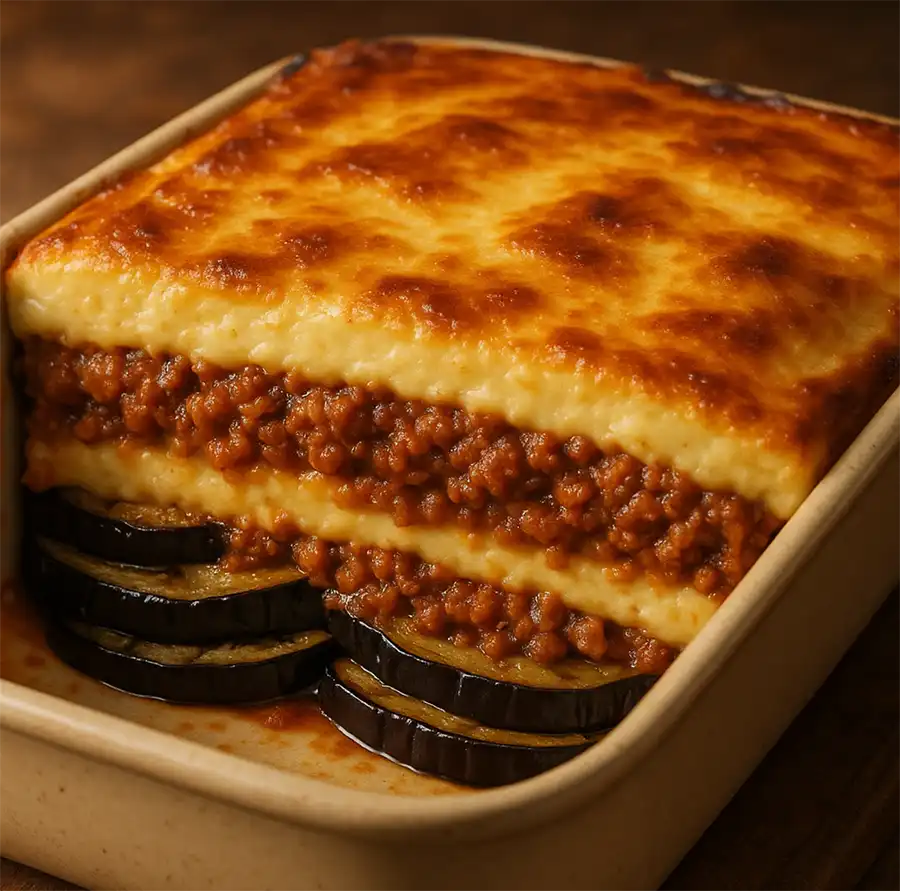
Moussaka is a legendary Greek dish that combines a multi-layered texture with the rich flavors and aromas of the Mediterranean. It is a hearty casserole consisting of fried eggplant, juicy minced meat, potatoes, and delicate béchamel sauce, baked until golden brown.
More than just a dish, moussaka is a true culinary masterpiece that symbolizes Greek hospitality and craftsmanship. It takes time and patience to prepare, but the result is worth all the effort—a fragrant, juicy casserole that will give you an unforgettable taste experience.
The history of the origin of moussaka
The history of moussaka has deep roots and is shrouded in mystery. According to one version, this dish is over 3,000 years old. The most likely origin of moussaka is associated with the Arab world, where a similar dish was called “musaqqa” (from the verb saqqa’a – to cool). In Arab countries, moussaka is often served as a cold salad made from tomatoes and eggplants.
The modern recipe for Greek moussaka with béchamel sauce was created in 1920 by Greek chef Nicholas Tselementes. He took an Arabic recipe with eggplant as a basis, added meat, and topped the dish with French béchamel sauce. It is this version that has become classic and spread throughout the world.
According to another version, moussaka spread throughout the Ottoman Empire from Persia, where maghama was prepared — a dish made from minced lamb and eggplant. From the Arab tradition, the dish found its way into Turkish cuisine, and from there it spread throughout the former lands of the Ottoman Empire, including Greece, Bulgaria, Serbia, and Romania.
Classic Greek moussaka recipe
Ingredients (for 8-10 servings):
For vegetables:
- 3-4 large eggplants (1-1.2 kg)
- 4-5 medium-sized potatoes
- 500-600 ml olive oil for frying
- Salt for sprinkling eggplants
For the meat sauce:
- 700-800 g minced meat (beef, lamb, or mixed)
- 2-3 medium-sized onions
- 400-500 g tomatoes or canned tomatoes
- 3-4 cloves of garlic
- 150 ml dry white wine
- 2-3 tablespoons of tomato paste
- 1 teaspoon dried oregano
- ½ teaspoon cinnamon
- ½ teaspoon sweet paprika
- Salt, black pepper to taste
- Bay leaves — 2 pieces
For the béchamel sauce:
- 50-60 g butter
- 50-60 g flour
- 500-600 ml of milk
- 2-3 eggs
- 200-250 g hard cheese (grated)
- ¼ teaspoon nutmeg
- Salt, white pepper to taste
Detailed step-by-step preparation:
1. Preparation and processing of eggplants
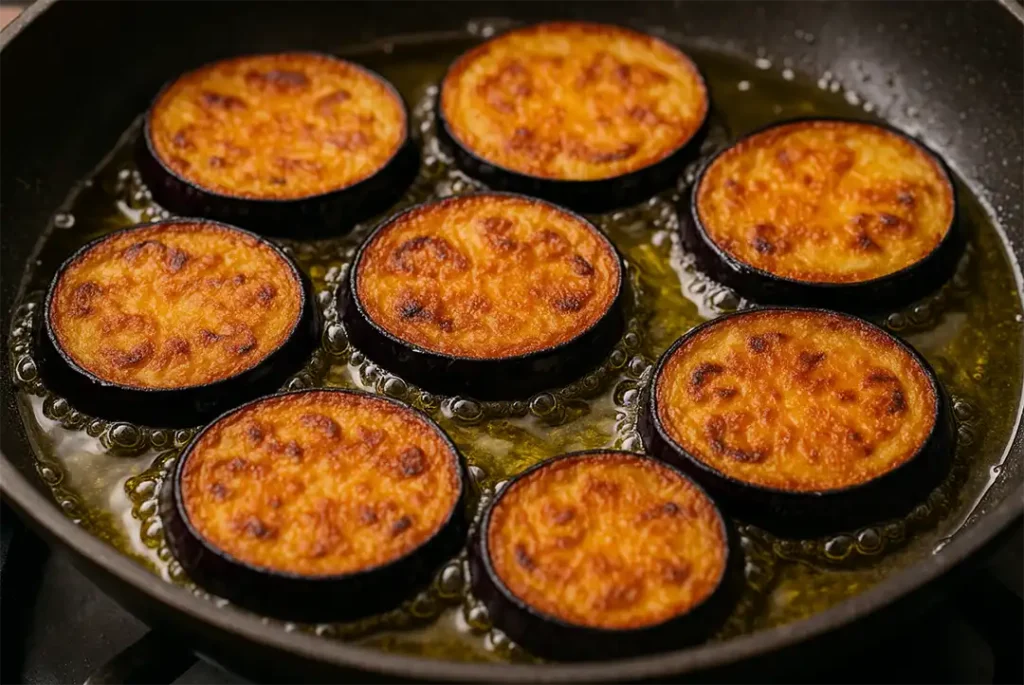
Wash the eggplants and cut them into 0.8-1 cm thick slices. Be sure to salt them and leave them for 20-30 minutes to remove the bitterness — this is one of the most important steps. Then rinse them with cold water and dry them thoroughly with paper towels.
Heat the olive oil in a frying pan to medium heat. Fry the eggplants on both sides until golden brown — about 3-4 minutes on each side. Do not try to fry all the eggplants at once — do it in batches so that they brown evenly.
Place the cooked eggplants on paper towels to remove excess oil. This is especially important because eggplants tend to absorb a lot of oil.
2. Preparing the potatoes
Peel the potatoes and cut them into 5-7 mm thick slices. Boil them in salted water until half cooked — this will take 5-7 minutes after boiling. The potatoes should still be slightly firm, as they will finish cooking in the oven.
Drain the potatoes in a colander and allow the water to drain completely. If desired, you can also lightly brown the potato slices in a frying pan with a small amount of oil.
3. Preparing a fragrant meat sauce
Finely chop the onion and fry in 2-3 tablespoons of oil until golden brown and translucent — this will take about 5-7 minutes. The onion should be soft and slightly caramelized.
Add the ground meat and fry over medium heat, breaking it up with a spatula, until it is completely browned—this will take 8-10 minutes. It is important to fry the ground meat well so that it acquires a rich flavor.
Peel the tomatoes (pour boiling water over them to do this) and chop them into small cubes. Chop the garlic or press it through a garlic press. Add the tomatoes and garlic to the minced meat.
Pour in the dry white wine and add the tomato paste, oregano, cinnamon, paprika, and bay leaf. Season with salt and pepper to taste. This combination of spices creates an authentic Greek flavor.
Simmer the meat sauce over low heat for 20-25 minutes, stirring occasionally, until the liquid has almost completely evaporated. The sauce should become thick and aromatic.
4. Preparing the béchamel sauce
Melt the butter in a heavy-bottomed saucepan over medium heat. When the butter has completely melted, add the flour and cook, stirring constantly with a whisk, for 2-3 minutes until a light nutty aroma appears. This mixture is called roux and is the basis for the sauce.
Preheat the milk until warm. Gradually pour the hot milk into the egg yolks in a thin stream, stirring vigorously with a whisk to prevent lumps from forming. This process requires patience and constant stirring.
Cook the sauce over low heat for 8-10 minutes until thickened, stirring constantly. The consistency should be like thick sour cream. Add salt, white pepper, and nutmeg.
Remove the sauce from the heat and let it cool slightly—about 5 minutes. Beat the eggs in a separate bowl and gradually add them to the warm (not hot!) sauce, stirring vigorously. This prevents the eggs from curdling.
Add ¾ of the grated cheese and stir thoroughly until completely dissolved.
5. Making moussaka — the art of layering
Preheat the oven to 180-190°C. Prepare a deep baking dish measuring approximately 30×40 cm or two smaller dishes.
Arrange the ingredients in layers in the following order:
- The first layer consists of potato circles arranged tightly next to each other.
- The second layer — half of the roasted eggplants
- The third layer is all the meat sauce, spread evenly.
- The fourth layer — the rest of the eggplants
- The fifth layer is béchamel sauce, spread evenly with a spatula.
Sprinkle the surface with the remaining grated cheese to form a golden crust.
6. Baking to perfection
Bake the moussaka in a preheated oven for 45-55 minutes until a beautiful golden crust forms. The surface should become golden brown and the sauce should thicken well.
After cooking, let the moussaka “rest” for 15-20 minutes at room temperature. This is very important — during this time, the layers will stabilize and the dish will be easier to cut.
Regional variations of moussaka
Bulgarian moussaka
The Bulgarian version of moussaka has its own characteristics and is mainly made with potatoes and minced meat. Instead of a complicated béchamel sauce, Bulgarians use an egg and milk mixture: they beat 3-4 eggs with a glass of milk or yogurt, add grated cheese, and pour this mixture over layers of potatoes and minced meat.
Sometimes spinach, white cabbage, or other vegetables are added to Bulgarian moussaka. This version is lighter and quicker to prepare, but no less delicious.
Turkish moussaka
In Turkey, moussaka is prepared in a completely different way — as a warm stew without distinct layers. Eggplant, tomatoes, and ground meat are stewed together with onions, garlic, and traditional Turkish spices.
Turkish moussaka has a thinner consistency and is served hot as a main dish with rice or bulgur. It is less filling than the Greek version, but has a bright, rich flavor.
Serbian and Macedonian moussaka
In the Balkans, moussaka is often prepared with fried potatoes as an essential ingredient. The Macedonian version includes layers of potatoes, eggplant, and meat under a cheese crust.
Serbian moussaka may contain zucchini, bell peppers, or even mushrooms. Each family has its own special recipe, passed down from generation to generation.
Romanian moussaka
In Romania, moussaka with tomatoes instead of eggplant or with a combination of these vegetables is popular. Sweet peppers and Romanian spices are often added, giving the dish a special Balkan character.
Modern and dietary variations
Vegetarian moussaka
The vegetarian version of moussaka has become extremely popular among healthy eaters. Instead of minced meat, they use:
- Mushroom mixture: a combination of white mushrooms, champignons, and oyster mushrooms with onions and seasonings
- Lentil filling: boiled green or red lentils with tomatoes and aromatic herbs
- White beans: chickpeas or beans stewed with vegetables
- Nut mix: chopped walnuts with herbs and spices
Vegetarian moussaka is just as filling and delicious, and easier to digest.
Moussaka with zucchini and squash
The summer version of moussaka includes zucchini or young squash instead of some of the eggplant. The vegetables are cut into thin slices lengthwise and lightly salted to remove excess water.
This moussaka is lower in calories and has a more delicate flavor. It is especially popular when zucchini is in season.
Low-calorie moussaka
For those who are watching their weight, there are several ways to reduce the calorie content of moussaka:
- Baking instead of frying: eggplants can be baked in the oven with a minimal amount of oil.
- Lean minced meat: use veal or turkey mince
- Yogurt sauce: replace part of the cream sauce with Greek yogurt
- More vegetables: increasing the proportion of vegetables relative to meat
Gluten-free moussaka
For people with celiac disease or gluten intolerance, you can prepare a gluten-free version by replacing the wheat flour in the sauce with:
- Corn starch
- Rice flour
- Potato starch
The taste remains virtually unchanged, and the dish becomes accessible to a wider range of people.
Tips and secrets for perfect moussaka
Professional secrets from the Greeks
Choosing the right eggplants: Choose young eggplants with shiny, taut skin without dark spots. They contain fewer seeds and have a less bitter taste.
Proper salting: generously sprinkle the sliced eggplants with coarse salt and leave for 30 minutes. This will not only remove the bitterness, but also reduce the amount of oil they will absorb during frying.
Oil temperature: Fry the eggplants over medium heat in well-heated oil. If the oil is not hot enough, the eggplants will absorb too much oil and become greasy.
Secrets of the perfect meat sauce
Quality of minced meat: use fresh minced meat that you have prepared yourself or buy it from trusted butchers. Good minced meat is the basis of delicious moussaka.
Proper frying: do not rush when frying minced meat. It should brown well and acquire a rich color — this will take at least 10 minutes.
Evaporation of liquid: simmer the sauce until the liquid has almost completely evaporated. Excess moisture can make the moussaka watery.
Balance of seasonings: Greek moussaka has a distinctive flavor thanks to the combination of cinnamon, oregano, and mint. Don’t be afraid to experiment with the proportions.
The art of béchamel sauce
Quality of ingredients: Use high-quality butter and fresh milk. This is the basis of a good sauce.
Temperature: cook the roux (a mixture of butter and flour) over medium heat, making sure it does not burn. The flour should brown slightly and acquire a nutty aroma.
Gradually pour in the milk: never pour in all the milk at once. Do this gradually, stirring constantly to avoid lumps.
The correct temperature for eggs: before adding eggs, the sauce should cool to a warm state. Hot sauce will curdle the eggs.
The art of assembling and baking
Even layers: Try to spread each layer as evenly as possible. This will ensure that each serving has the same proportion of ingredients.
The right pan: Use a pan that’s deep enough (at least 7-8 cm) so all the layers fit comfortably.
Baking time: don’t rush the baking process. Musatsi needs time for all the flavors to blend and the sauce to thicken.
The importance of resting: be sure to let the finished moussaka stand for 15-20 minutes before cutting. This will allow the layers to stabilize.
Nutritional value and beneficial properties
Calorie content and macronutrients
Classic Greek moussaka is a fairly high-calorie dish due to its oil, meat, and sauce content. Per 100 g of the finished dish, there is approximately:
- Calories: 160-200 kcal
- Protein: 12-15 g
- Fats: 10-14 g
- Carbohydrates: 8-12 g
- Fiber: 3-4 g
However, the exact calorie content depends on the method of preparation and the proportions of the ingredients.
Useful properties of the main ingredients
Eggplants are a real treasure trove of beneficial substances:
- Low in calories (25 kcal per 100 g) and high in fiber
- Rich in anthocyanins — powerful antioxidants that protect the heart and brain
- Contains nazunin, a substance that protects nerve cells.
- Potassium and magnesium support cardiovascular health
- Folic acid is beneficial for blood formation.
Minced meat provides the body with:
- Complete proteins with all essential amino acids
- Iron, which prevents anemia
- Vitamins of group B, especially B12
- Zinc for the immune system
Béchamel sauce with milk and cheese provides:
- Calcium for healthy bones and teeth
- Phosphorus for normal metabolism
- Vitamin A for vision
- Riboflavin (B2) for energy metabolism
Dietary modifications
To reduce calorie intake, you can:
- Bake eggplants instead of frying them
- Use lean ground meat (beef, turkey)
- Replace part of the cream sauce with Greek yogurt.
- Increase the proportion of vegetables relative to meat
- Use less cheese
A vegetarian version with lentils or mushrooms will contain less saturated fat and more fiber.
Serving and accompaniments
Traditional serving
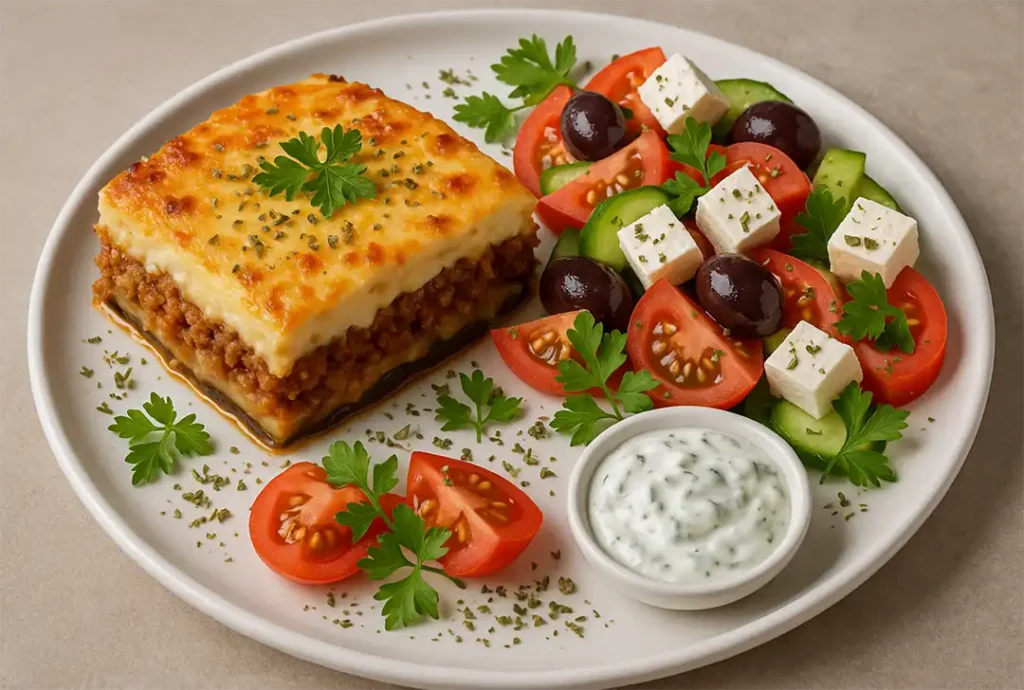
In Greece, moussaka is traditionally served warm (not hot) as the main dish for lunch or dinner. Best accompaniments:
Greek salad (horiatiki): fresh tomatoes, cucumbers, bell peppers, red onions, olives, feta cheese, dressed with olive oil and oregano.
Tzatziki sauce: thick yogurt with grated cucumber, garlic, and mint. This refreshing sauce perfectly balances the richness of moussaka.
Fresh bread: traditional Greek bread or pita bread for wiping the plate.
Wine: dry red wine, such as Greek Assyrtiko or Retsina.
Modern serving options
- Mixed salad: light salad with arugula and baby spinach with lemon dressing
- Baked vegetables: zucchini, peppers, cherry tomatoes baked with herbs
- Olives and cheese: assortment of Greek olives and various cheeses
- Lemon rice: fragrant rice with lemon juice and herbs
Presentation of the dish
It is best to cut moussaka into square or rectangular portions using a sharp knife. Place on warmed plates and garnish:
- Fresh herbs (parsley, basil, oregano)
- A drop of high-quality olive oil
- Thin slices of fresh tomato
- Kalamata olives
Storage and reheating
Storage rules
In the refrigerator: Ready-made moussaka can be stored in the refrigerator for 3-4 days in a tightly sealed container or under plastic wrap.
Freezing: Moussaka can be frozen whole or in portions. It can be stored in the freezer for up to 3 months at -18°C.
For freezing:
- Cool the finished dish completely.
- Wrap in aluminum foil or place in a freezer container.
- Sign the date of preparation
- Freeze at the lowest possible temperature
Proper warm-up
From the refrigerator: reheat in the oven at 160°C for 15-20 minutes, covered with foil to retain moisture.
From the freezer: defrost in the refrigerator for 8-12 hours, then reheat as usual.
In the microwave: heat on medium power, covering with a microwave lid to prevent drying out.
Tip: When reheating, add a little water or broth if the moussaka seems dry.
Preparation of semi-finished products
Moussaka can be partially prepared in advance:
- Full preparation: assemble all layers in the pan, but do not bake. Cover tightly and refrigerate for up to 24 hours, then bake as usual.
- Individual components: prepare the meat sauce and fry the eggplants in advance. Store separately in the refrigerator for up to 2 days.
- Freezing semi-finished products: assembled but unbaked moussaka can be stored in the freezer for up to 2 months.
Common mistakes and how to avoid them
The most common mistakes made by beginners
Incorrect preparation of eggplants: the most common mistake is skipping the salting stage. This leads to a bitter taste in the finished dish.
Overcooked moussaka: insufficient evaporation of liquid from the meat sauce makes the finished dish watery and unappetizing.
Poorly prepared béchamel sauce: lumps in the sauce or separation spoil the texture and appearance of the dish.
Incorrect baking temperature: too high a temperature causes the surface to burn while the inside remains raw.
How to fix errors
If the moussaka turned out to be bitter: it can be partially corrected by serving a dish with sour sauce (dazziki) or lemon juice.
Якщо мусака занадто жирна: в наступний раз використовуйте менше олії для смаження баклажанів або запікайте їх.
If the Béchamel sauce is rolled: Strain the sauce through a sieveта збийте блендером до гладкості.
If the moussaka breaks up: give it more time for a “rest” after baking.
Interesting facts about Musaka
culturally significant
Musaka in Greek culture is not just a dish, but a symbol of family traditions and hospitality. Cooking moussaka is often a family affair, where every woman passes on her special recipe to daughters and daughters-in-law.
In Greece, there is a saying: “Musaka as life – needs patience, but the result is worth all efforts.” This reflects the philosophical attitude of the Greeks to cooking and life in general.
Musaka in the literature tа movie
Musaka is mentioned in many works of Greek writers as a symbol of home comfort and maternal care. In the popular film “My Great Greek Wedding” Musaka appears on the family table as a mandatory attribute of the Greek holiday.
Record mousseаки
In 2010, the world’s largest moussaka weighing more than 200 kilograms was cooked in the Greek city of Athens. It took about 8 hours and the participation of 15 chefs.
Frequently asked questions(FAQ)
Why does moussaka break up when cut?
This is most often due to the fact that the moussaka was cut too hot or the bechamel sauce was not thick enough. Be sure to let the dish cool for 15-20 minutes after removing from the oven and watch the consistency of the sauce during cooking.
Can you cook moussaka without meat?
Absolutely yes! Vegetarian versions with mushrooms, lentils, chickpeas or white beans are no less delicious and filling. Add more seasonings and herbs for nасиченого смаку.
What is the best meat to use for moussaka?
Traditionally, lamb is used, but beef or mixed minced meat (beef + veal) also give excellent results. The main thing is that the stuffing was fresh and not too low-fat.
Is it necessary to salt eggplant?
Yes, this is a critical procedure. Salting not only removes bitterness from eggplant, but also reduces the amount of oil they absorb during frying. It is not recommended to skip this stage.
Can I replace the bechamel sauce with something else?
Classic Greek moussaka is prepared with béchamel, but you can use thick Greek yogurt, sour cream and egg filling or even cream sauce. However, the taste will be different from the authentic one.
How long does moussaka cook from start to finish?
Full cooking takes 3-3.5 hours: 1 hour to prepare all the ingredients, 30 minutes for folding, 50 minutes of baking and 20 minutes to cool. It’s not a quick meal but the result того варто.
Can you freeze ready-made moussaka?
Yes, you can freeze ready-made, cooled moussaka in portions or whole in the freezer for up to 3 months. Defrost in the refrigerator overnight and reheat in the oven at 160°C.
Why is moussaka too fatty?
To reduce the fat content, bake the eggplants in the oven with a minimal amount of oil instead of frying them, use lean minced meat, and drain the oil from the fried eggplants well on paper towels.
What to do if the béchamel sauce has lumps?
Strain the sauce through a fine sieve, then blend with a blender or mixer until smooth. In the future, keep a closer eye on the temperature and stir constantly during cooking.
When is it better to serve moussaka—hot or warm?
Moussaka tastes best when warm, about 15-20 minutes after removing it from the oven. During this time, the layers stabilize, the flavors blend, and the dish is easy to cut and serve.
Can you make moussaka in a multicooker?
Yes, you can adapt the recipe for a multicooker, but the result will be slightly different from that of an oven. Use the “bake” mode and be prepared for the surface not to develop the same golden crust.
What are the best accompaniments for moussaka?
Traditionally, moussaka is served with Greek salad, tzatziki sauce, fresh bread, and dry red wine. Modern variations include light leafy salads, roasted vegetables, or simply fresh tomatoes with olive oil.
Musaka is not just a recipe, but a culinary art that combines traditions, taste and care. Cooking this dish can be a real meditation and a way to show love for loved ones. Experiment with ingredients, find your favorite combinations, but always remember the basic principles – quality products, patience and love of cooking.