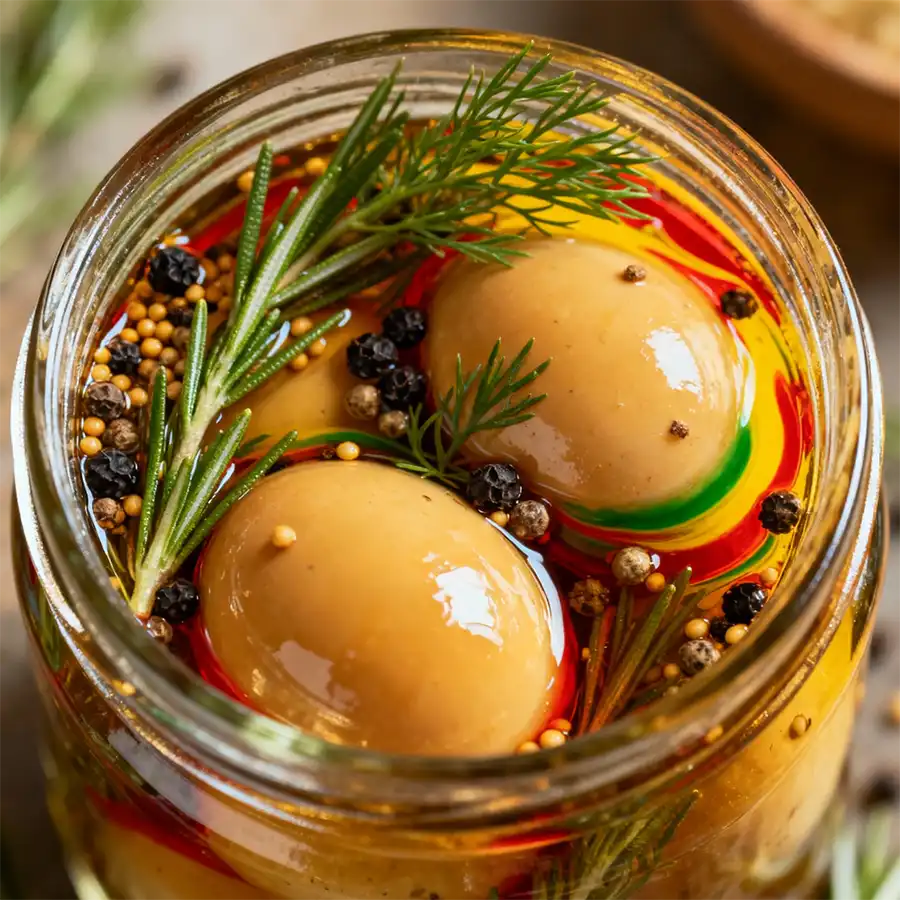
Main about pickled eggs — a calendar tradition that was received by the world
Marinated eggs are a more elaborate appetizer than the simple snack. This dish has a rich history, starting from the necessity of preserving eggs for long-term storage and finishing with modern gastronomic experiments. In different cultures around the world, unique pickling techniques have developed — from classic British recipes with vinegar to advanced Chinese marmalade eggs in tea pickle and spicy Korean variations with soy sauce.
Today, pickled eggs are experiencing a true revival of popularity due to a trend towards homemade preparations, crafted use, and gastronomic experiments. They have become an indispensable part of bar culture, festive tables, and healthy eating.
Content
History of Marinated Eggs in the World
Origin of the Conservation Tradition
Marinated eggs emerged as a practical necessity for the long-term storage of products. The earliest mentions of similar techniques date back to the 14th century — the oldest known recipe comes from Cairo. The Arabic recipe “Baid Mukhallal” involved the marination of eggs in a wine-derived vinegar, combined with salt and coriander.
British Barrel Culture
In Great Britain, marinated eggs became a genuine tradition in pubs as early as the 1830s. They were served as a common accompaniment to beer, which stimulated the consumption of alcohol and provided clients with survival options. An interesting fact: the purest, amino-acid-rich solutions that can be found in eggs somewhat compensate for the aging process with alcohol and reduce hangover effects.
Asian Interpretations
In China, there developed a tradition of “marbleized” or “tea eggs” — eggs that are marinated in tea, soy sauce, and spices. This technique creates characteristic marbled patterns on the egg’s surface that resemble pavements or natural stones. In Korea, the popular guest dish is marinated eggs with pasta from unconventional ingredients.
Detailed Classic Recipe of Marinated Eggs
Essential Ingredients for the Basic Recipe
Essential Ingredients:
- Fresh chicken eggs — 10-12 pcs.
- Filtered water — 500 ml
- 9% cream (or 6% sour cream) — 300-400 ml
- Salt — 1-1.5 tbsp.
- Sugar — 1-2 tbsp.
Spices and Seasonings:
- Bay leaf — 3-4 pcs.
- Black peppercorns — 10-15 pcs.
- Pimento (Jamaican) — 5-7 pcs.
- Cloves — 4-6 pieces
- Mustard seeds — 1 tsp.
- Groats (fresh or canned) — as needed
- Red hot pepper — to taste
Cooking Process Preparation
Step 1: Proper Egg Separation
The technique for separating the eggs critically affects the final result. Use room temperature eggs — this will reduce the risk of curdling. Place the eggs in a bowl, cover them with cold water 2-3 cm above the eggs. Add a pinch of salt to prevent curdling.
Add to the pile at medium heat, later reduce the heat and boil:
- 8-9 minutes for a delicate center
- 10-11 minutes for a classic creamy egg
- 12 minutes for a fully hard yolk
Lifehack from chefs: After boiling, immerse the eggs in cold water for 1-2 minutes, then briefly in hot water for 30 seconds. This technique “double boiling” makes peeling boiled eggs remarkably easy.
Step 2: Cleaning and Preparation
The cleaned eggs are typically smooth on the surface without any imperfections. If you plan to limit the salting, make a few precise holes with a toothpick, but this reduces the preservation time.
Step 3: Preparing the Marinade
In a stainless steel pot or an enamelled container, mix water, vinegar, salt, sugar, and all the spices. Bring to a boil and retain for 3-5 minutes to dissolve the aromas of the spices. Allow to cool to room temperature.
Important Detail: Hot marinade can create a white “foam”, so it is essential to submerge fully for cooling.
Step 4: The Marination Process
In a sterile glass jar or food container, carefully pour in the eggs. Pour over the cooled marinade so that it completely covers the eggs. If necessary, use a small plate to keep the eggs submerged.
Marinating Times:
- Minimum time — 12-24 hours (light brine)
- Optimal — 3-5 days (balanced taste)
- Maximum — 7-10 days (intense flavor)
Step 5: Storage and Serving
Store exclusively in the refrigerator at a temperature of +2°C to +4°C. Before serving, let it sit for 15-20 minutes to restore the brine quality at room temperature.
World Variations of Marinated Eggs
1. Chinese Marble Eggs

This technique creates incredibly beautiful marble-patterned eggs on the surface of the whites.
Ingredients:
- Eggs — 6-8 pcs.
- Black tea (preferably puer) — 3 tbsp.
- Soy sauce — 4 tbsp.
- Dark soy sauce — 1 tbsp.
- Star anis — 2 pcs.
- Cinnamon — 1 stick
- Cloves — 5-6 buds
- Seasoning “5 spices” — 1 tsp.
Preparation method:
Boil the eggs for 8 minutes, chill and accurately crack the shell, creating a mesh of fractures. Prepare the marinade from all the ingredients and 3 cups of water. Soak the eggs in the marinade for 20-30 minutes on minimum heat, then leave them for 4-8 hours.
2. Korean Spicy Marinated Eggs
A pickled version with characteristic Korean flavors.
Ingredients:
- Eggs — 6-8 pcs.
- Soy sauce — 200 ml
- Water — 150 ml
- Kochujang (Korean chili paste) — 2 tbsp.
- Rice vinegar — 2 tbsp.
- Sesame oil — 1 tsp.
- Garlic — 4 cloves
- Ginger — 2 cm piece
- Sugar — 1 tsp.
- Sesame seeds — for serving
3. Quail Eggs Marinated with Beet
Miniature eggs with colorful vibrant glaze.
Use 15-20 marinated quail eggs (around 4-5 minutes). Add to the marinade a piece of one boiled beet or thin slices of raw beet. The eggs will acquire a rose-pink hue in 24-48 hours.
4. German pickled eggs with onions
Traditional recipe for pickled eggs.
The marinade is made from apple cider vinegar, sugar, salt with added beet, onion, cloves, and cinnamon. The eggs have a sweet-and-sour taste and a bright color.
5. Irish pub marinated eggs
Classic of Irish pubs with a unique selection of spices.
Two types of vinegar are used (apple and balsamic), added are herbs, rosemary, thyme, and a variety of mustard seeds.
Nutritional value and benefits of pickled eggs
Energy value
In 100 grams of pickled eggs, there are:
- Calories: 148-167 kcal
- Proteins: 11-13.2 g
- Fats: 10-11.6 g
- Carbohydrates: 0-1.2 g
- Sodium: 400-500 mg
One average pickled egg (50 g) contains approximately 77-80 kcal.
Vitamins and minerals
Pickled eggs retain most of the beneficial substances usually found in eggs:
Vitamins:
- Vitamin A — supports vision and immunity
- Vitamin B groups (B2, B6, B12) — nervous system and metabolism
- Vitamin D — bone health
- Vitamin E — antioxidant properties
- Choline — functions of the brain
Minerals:
- Iron — blood formation
- Zinc — immune system
- Selenium — antioxidant protection
- Phosphorus — bones and teeth
- Potassium — cardiovascular system
Advantages for health
1. High-quality protein
The egg contains all the essential amino acids in optimal proportions. The protein in the egg has the highest biological value among all food products.
2. Maintaining weight
Dishes with high protein content, such as eggs, ensure a lasting feeling of fullness with relatively low caloric intake.
3. Eye health
Carotenoids and zeaxanthin in yolks protect against degeneration of the yellow spot.
4. Improvement of digestion
Quail eggs can stimulate the production of bile and improve the absorption of vital nutrients.
Safety when consuming
Increased content of nutrients: Quail has a significant amount of protein, which can be problematic for people with hypertension.
Cream in quail eggs: Some recipes contain considerable amounts of added cream.
Acidity: Vinegar can exacerbate ulcers in individuals with gastritis or ulcerative colitis.
Professional Secrets and Techniques

Selection of Quality Eggs
Freshness of Eggs: Ideally, for the best quality, choose eggs that are 7-10 days fresh. They are easier to peel from the shell.
Size: Use eggs of the same size for even cooking.
Home vs Store-Bought: Home-grown eggs typically have a richer flavor and a brighter yellow color, while store-bought eggs often have a more consistent shell.
Techniques for Creating Ideal Texture
Temperature Control: Different temperatures yield different textures. Ensure the eggs reach room temperature before cooking.
Optimal pH of Marinade: An acidity of 3.5-4.0 ensures optimal penetration of flavors without compromising the structure of the proteins.
Exposure Time: Excessive exposure during marination (more than 2 weeks) can lead to a “gummy” texture.
Creating Unique Flavor Profiles
Layering Special Techniques:
- First layer — base spices (laurel leaf, pepper)
- Second layer — aromatic (juniper, ginger)
- Third layer — finishing (fresh herbs, cedar)
Utilization of Various Types of Vinegar:
- Yabluchny – fruity, soft
- Vynny – elegant, vintage
- Rysovyi – delicate, ice-sweet
- Balzamychnyi – aromatic, with caramel notes
Coloristic Techniques
Natural Colorants:
- Burjak – rosy-red
- Kurkuma – golden-yellow
- Red Cabbage – blue-purple
- Marker Seik – orange
- Onion Skin – brown
Made with Gradients: Combine colorants at different levels for creating ombre effects.
Innovative Variations and Current Trends
Molecular Gastronomy
Sphere Marinated Eggs: Utilizing alginate in natural forms for creating a spherical center in culinary preparation.
Capsule Eggs: The degradation technique of marinating in microdrops for creating concentrated flavored bombs.
Fermented Variations
Japanese Miso-Egg: Marination in paste creates umami-flavored eggs.
Kimchi-Egg: Utilizing juice from fermented cabbage for creating kimchi-flavored eggs.
Vegetarian Alternatives
Regardless of what eggs are not vegan products, there are interesting plant-based alternatives:
- Marinated Tofu-Eggs
- Eggs and mushroom caps stuffed with cheese
Methods of Serving and Presentation
Classic Presentation
As an appetizer: Serve halved hard-boiled eggs on wooden boards with pickled sauces and fresh greens.
In salads: Boiled eggs pair wonderfully with leafy salads, avocados, and herbs.
For drinks and cocktails: The traditional bar presentation — whole eggs in small cups.
Festive Presentation
Canapes: On a toasted slice of bread topped with premium butter and marinated vegetables.
Fresh snacks: On plates with cheese cubes and olives.
Decorative compositions: Using a variety of egg colors for creating rainbow plates.
Gastro Complimentary Serving
With cheeses: Especially good with soft cheese varieties and camembert.
With fish: Smoked mackerel, salmon, or tuna.
With vegetables: Pickled cucumbers, tomatoes, and radishes.
With sauces: Mustard with honey, aioli with garlic, ranch dressing.
Seasonal and Holiday Variations
Large Egg
Utilize natural dyes for crafting traditional colors:
- Golden yellow onion skins — golden-yellow
- Beetroot — pink and red
- Spinach — green
- Blackcurrants — blue and violet
Halloween Eggs
Marbled tea eggs are ideally suited for Halloween themes — they can be presented under the titles “Ghostly Eggs” or “Witchy’s Eggs”.
New Year Golden Eggs
Chinese marbled eggs traditionally symbolize gold and silver, making them an ideal fit for New Year’s celebrations.
Paschal Eggs – Orthodox
Garnishing the holiday table with herbs and flowers, which are used for Paschal dishes — mint, basil, and dill.
Storage and Preservation Processes
Storage Conditions
Temperature regime: Strictly from +2°C to +4°C in the primary cold storage department.
Container: Sealed jars with metal lids or food containers made from BPA-free plastic.
Labeling: Always date the start of the marination.
Preservation Methods
In the marinade:
- Homemade mayonnaise — up to 2 days
- Store-bought mayonnaise — up to 10 days
- Procolated mayonnaise — no more than 5 days
After extraction from the marinade:
- In the refrigerator — 2-3 days
- At room temperature — no more than 2 hours
Signs of spoilage
Unmistakable symptoms:
- Unpleasant odor (do not confuse with the aroma of vinegar)
- Sticky layer on the surface
- Contaminated marinade
- Soft spots on the surface
Common mistakes and how to avoid them
Mistakes in boiling
Overheating: Yellow with a green ring is the result of prolonged or intense boiling.
Temperature fluctuation: Sudden temperature shifts or aging mayonnaise.
Heavy cleaning: Usually fresh mayonnaise or inappropriate cooling.
Mistakes in marinating
Usually concentrated marinade: The ratio of vinegar to water more than 1:1 makes sauce usually acidic.
Hot marinade: Ruins the structure of the yolk.
Insufficient sterility: May lead to premature spoilage.
Mistakes in storage
Room temperature: Dangerous for the development of botulism.
Metal vessel: The assessment can interact with metal.
Repeated use of marinated: Uncertain from a hygienic standpoint.
Medicinal aspects and prototyping
Advantages for health
Probiotic properties: The assessment can stimulate the growth of beneficial bacteria.
Control of sugar in blood: The assessment may help regulate sugar levels.
Detoxification: Some species (mushroom, vegetables) have detoxifying properties.
Prototyping
Hypertension: High levels of nitrates may decrease blood pressure.
Renal protection: Limit consumption through nitrates.
Gastritis and ulcers: Acidity may provoke irritation.
Allergies: From egg or components of marinade.
Recommendations for doctors
Permissible consumption: No more than 1-2 eggs per day for healthy adults.
For children: Due to increased content of salts and spices.
Pregnancy: Consult a doctor through the risk of listeriosis.
Expanded FAQ section
General questions
Q: Can you consume pickled eggs every day?
A: Moderate consumption (1-2 eggs per day) is generally safe for healthy individuals. However, pay attention to the high salt content in the brine.
Q: How many calories are in pickled eggs?
A: An average pickled egg contains approximately 77-80 calories, which is only slightly more than a normal hard-boiled egg due to the salt in the brine.
Q: Do pickled eggs retain beneficial properties?
A: No, most vitamins and minerals are lost. Pickling may actually enhance the storage of certain vinegar-based substances.
Technical Questions
Q: Why are my pickled eggs so hard?
A: The most common reasons are over-pickling, usually using a concentrated or hot brine, and prolonged pickling time.
Q: How to create the ideal pickled cucumber?
A: The key is in the correct recipe. Create a uniform brine solution, without removing the cucumber completely.
Q: Can I reuse pickling brine?
A: It is better to prepare new brine for each batch for consistency and food safety.
Canning Questions
Q: Which eggs are better – homemade or store-bought?
A: For pickling, both types can work. Homemade usually has a stronger flavor, while store-bought – a standard quality and size.
Q: How can I make the eggs less sour?
A: Reduce the amount of vinegar in the marinade or add more sugar and sweet spices (cinnamon, vanilla).
Q: Is it possible to marinate eggs in a brine?
A: Yes, but the shelf life of the brine is limited (up to 3 days), and special precautions are needed for transportation.
Brine and Storage
Q: How to recognize brined eggs?
A: Unpleasant odor, slimy texture, cloudy brine, soft spots on the egg—these are all signs of spoilage.
Q: Is it possible to store brined eggs?
A: It is not recommended, as storage alters the texture of the egg white.
Q: How long can the opened jar be kept?
A: In the refrigerator for 2 weeks, as long as the eggs remain submerged in the brine.
Regional Specificities and Cultural Traditions
Ukrainian Traditions
In Ukraine, brined eggs are increasingly popular, but already unique recipes with local ingredients are emerging:
- Adding a selection of seasonal vegetables (beet, carrot, onion)
- Using homemade apple cider vinegar
- Herbs from Ukrainian fields (dill, coriander)
American Traditions
In the USA, particularly popular are pickled eggs made with beet juice. They have become a symbol of local festivals and fairs.
Asian Variations
Japanese Ajitsuke Tamago: This egg is immersed in a savory marinade, a traditional topping for ramen.
Thai Kai Yeo Ma: Silky eggs in palm sugar syrup and fish sauce.
Presentation and Photography
Rules for Attractive Presentation
Colorful Gamma: Combine eggs of different colors to create visually appealing compositions.
Textural Contrasts: Add crunchy elements (such as nuts, seeds) to the creamy texture of the eggs.
Height of Presentation: Use varying heights of plates and stands.
Photography for Social Media
Lighting: Natural daylight enhances the colors of marinated eggs the best.
Composition: Apply the rule of thirds—place the egg not in the center of the shot.
Rekvisit: Wooden boards, linens, fresh herbs create an atmosphere of homeliness.
Business Aspects and Commercial Manufacturing
Home Business
Marinated eggs can become the basis for a small food business:
- Sales at farmers’ markets
- Supplies to local restaurants
- Online sales through social media
Quality Requirements
Certification: For commercial production, the necessary approvals and certifications are required.
Standardization: Development of standard recipes and quality control.
Packaging: Special packaging for transportation and preservation.
Highlights and Perspectives
Marinated eggs — this is not just a snack, but a true culinary masterpiece with a rich history. From simple British pickled eggs to exquisite Chinese marinated creations — each culture has contributed its unique touch to the evolution of this tradition.
Contemporary trends in healthy eating, homemade preparations, and gastronomic experiments are making marinated eggs increasingly popular. They combine high nutritional value, ease of preparation, and limitless possibilities for creativity.
By mastering basic techniques and principles, you can create unique variations, experiment with flavors and colors, as well as adapt recipes to suit your own taste preferences and dietary needs.
Key principles of success:
- Quality ingredients and fresh eggs
- Maintaining the correct temperature regime
- Proper proportions of marinade
- Patience in the preservation process
- Creative approach to experiments
The marinated eggs continue to evolve, combining traditional techniques with modern culinary innovations. They remain a symbol of home comfort, gastronomic culture, and a creative approach to preparing food.
Attention to safety: Always adhere to hygiene rules, use a sterile jar, and do not violate storage conditions. In case of any doubts regarding the quality of the product, it is better to discard it.
Experiment, create, and enjoy the unique flavor of the world of marinated eggs — from classic recipes to personal culinary discoveries!