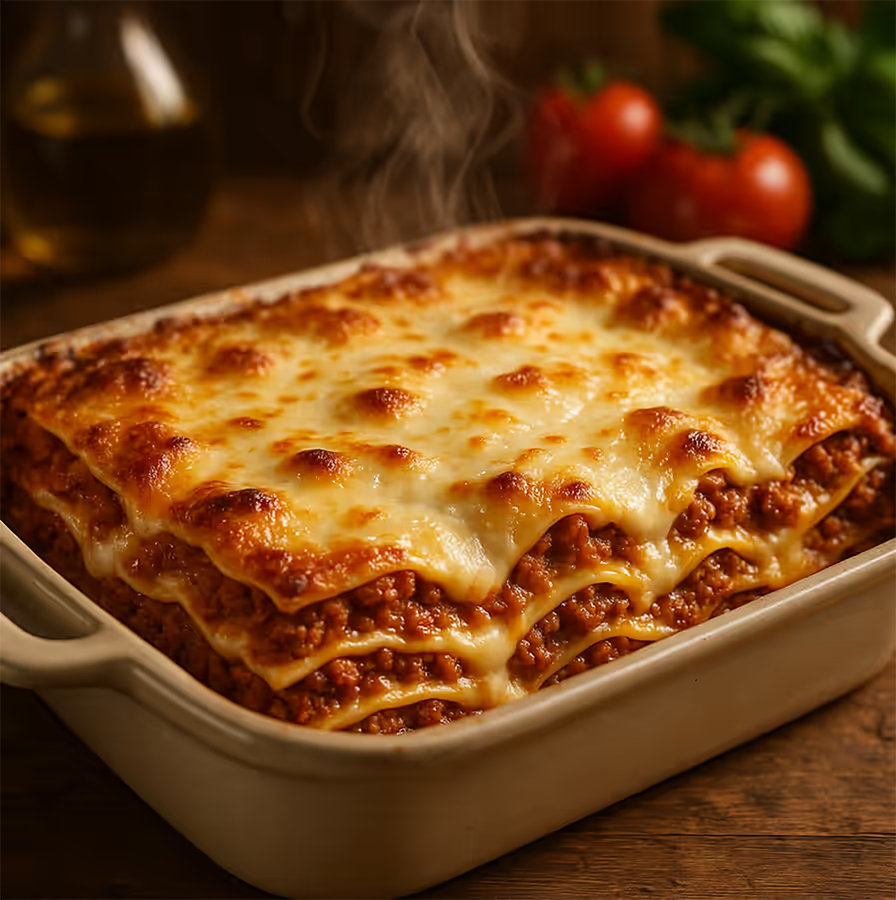
Lasagna is one of the most beloved Italian dishes, which has won the hearts of people all over the world. It is a multi-layered dish with a distinctive texture, delicate sauce, and rich flavor. Classic lasagna with meat and two sauces — béchamel and Bolognese — requires time and attention to detail, but the result is worth it. In this article, you will learn everything you need to know to make the perfect lasagna: from choosing ingredients to assembling and baking. In addition, we will look at interesting variations, common mistakes, and answers to the most popular questions.
Content
History and origin of lasagna
Lasagna has deep roots in Italian culinary tradition. Its history dates back to the Renaissance, when this dish was considered a luxury available only to the wealthy classes of society. The modern version of lasagna Bolognese originated in the Emilia-Romagna region of northern Italy, where it developed over centuries as a symbol of hospitality and culinary skill.
The name “lasagna” comes from the ancient Roman name for a cooking dish — lasanum. Over time, this term came to refer to the dish itself, which consists of wide, flat pasta that forms the basis of this dish.
Classic recipe for lasagna Bolognese
Ingredients (for a 25×35 cm baking pan, 8-10 servings)
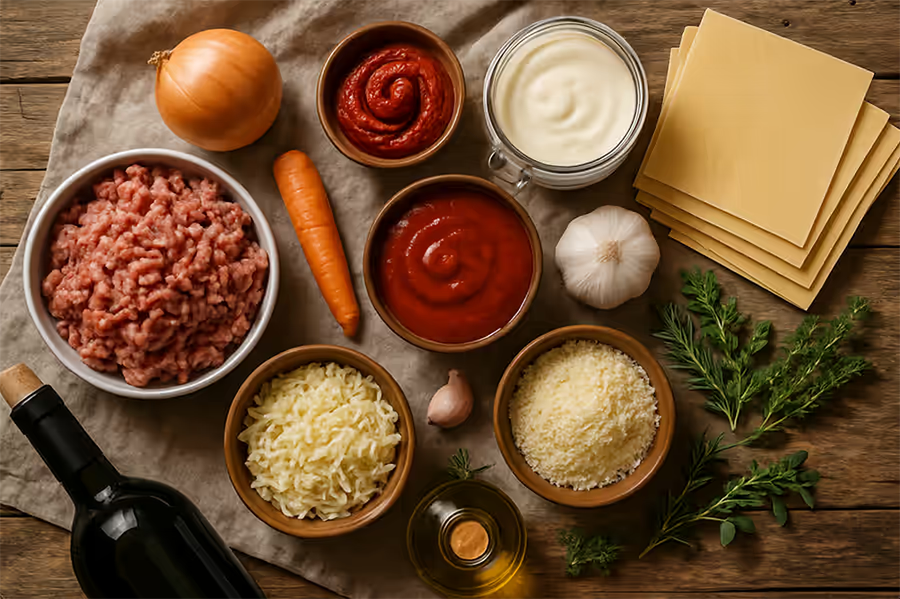
For the Bolognese sauce:
- Ground beef — 600 g
- Ground pork — 400 g
- Onions — 200 g (2 medium heads)
- Carrots — 150 g
- Garlic — 3-4 cloves
- Tomato paste — 4 tablespoons
- Tomato puree — 300 ml
- Red dry wine — 150 ml
- Olive oil — 4 tablespoons
- Dried basil — 2 teaspoons
- Dried oregano — 1 teaspoon
- Salt and black pepper — to taste
- Meat or vegetable broth — 200 ml
For the béchamel sauce:
- Butter — 100 g
- Wheat flour — 100 g
- Milk (whole, 3.2% fat) — 1 liter
- Salt — ½ teaspoon
- Nutmeg (ground) — ¼ teaspoon
- White pepper — a pinch
For assembly:
- Lasagna sheets, dried or fresh — 400 g (approximately 18-20 sheets)
- Parmesan cheese, grated on a fine grater — 200 g
- Mozzarella cheese, grated on a medium grater — 200 g (optional, for extra stretchiness)
Step-by-step recipe
Step 1: Preparing the Bolognese sauce (time: 75-90 minutes)
Prepare the vegetables. Peel the onion and carrots. Cut the onion into small cubes about 3-4 mm in size. Grate the carrots on a medium grater or cut them into small cubes. Crush the garlic with a knife, then chop it finely.
Sautéing vegetables. Heat olive oil in a large skillet or saucepan with a thick bottom over medium heat. When the oil is hot, add the onion and sauté for 5-7 minutes, stirring constantly with a wooden spatula, until the onion is soft and slightly golden.
Add carrots and garlic. Add grated carrots to the fried onions and stir for 2-3 minutes. Then add minced garlic and cook for another minute until the characteristic aroma appears.
Adding meat. Place both types of minced meat — beef and pork — in the pan. Using a wooden spatula, break up the meat into small pieces so that it cooks evenly. Fry over medium-high heat for 10-12 minutes, stirring constantly, until the meat changes color and turns brown. This is an important step because it develops the deep flavor of the meat.
Add tomatoes and spices. When the meat is ready, pour in the tomato paste and stir it into the meat for 2 minutes so that the paste coats all the minced meat well. Then add the tomato puree and stir. Pour in the red wine and cook the mixture over medium heat for 5 minutes to allow the alcohol to evaporate, leaving a wonderful flavor.
Add spices and seasonings. Add dried basil, oregano, salt, and pepper to taste. Remember that raw sauce will have a stronger flavor than cooked sauce, so don’t add too much salt.
Simmering. Reduce the heat to low (the sauce should barely simmer), add meat or vegetable broth, and cover with a lid, leaving a small gap for moisture to evaporate. Cook the sauce for 60 minutes, stirring occasionally (every 10-15 minutes). The sauce should become thick, dark brown, and leave oil on the surface. If the sauce becomes too thick, add a little hot water. The finished Bolognese sauce will have the consistency of liquid sour cream.
Step 2: Preparing the béchamel sauce (time: 15-20 minutes)
Preparation of roux (base). Melt butter in a heavy-bottomed saucepan over medium heat. When the butter is completely melted, add wheat flour and stir thoroughly with a wooden spatula or whisk to prevent lumps from forming. Cook the mixture (roux) for 2-3 minutes, stirring constantly, until the flour turns a light golden color. This step develops the flavor and eliminates the raw taste of the flour.
Adding milk. Remove the saucepan from the heat for a few seconds. Gradually pour in the milk, stirring constantly with a whisk to prevent lumps from forming. Start with a small amount of milk (100-150 ml) to obtain a smooth paste, then gradually add the rest of the milk, stirring constantly. This will prevent lumps and ensure a smooth sauce.
Cooking the sauce. Return the saucepan to the heat and cook the sauce over medium heat, stirring constantly with a whisk, until it thickens to the consistency of liquid sour cream. This will take about 8-10 minutes. The sauce should be thin enough to pour but thick enough to cling to the plate.
Add spices and seasonings. Remove the sauce from the heat. Add salt, nutmeg, and white pepper, and stir thoroughly. Nutmeg is essential for béchamel sauce—it adds a distinctive flavor that is recognizable in classic lasagna. If using fresh nutmeg, grate it on a very fine grater directly into the sauce.
Cooling. Allow the béchamel sauce to cool to room temperature or slightly warmer. The surface of the sauce hardens quickly, so place parchment or plastic wrap directly on the surface to prevent a crust from forming.
Step 3: Preparing the lasagna sheets
Choosing sheets. If you are using dry lasagna sheets that need to be boiled, read the instructions on the package. Some sheets cook in 2-3 minutes, others take longer. If you are using modern “no-boil” sheets (ready to use), you can use them straight from the package, although some cooks recommend soaking them in hot water for 10 minutes.
Cooking the sheets. Boil water in a wide pot or cauldron. Add a pinch of salt. Carefully place the lasagna sheets in the water, 2-3 at a time, so that they do not stick together. Cook the sheets according to the time indicated on the package. 30 seconds before the end of cooking, check if they are ready — the sheet should be soft but not fall apart when lifted with a fork.
Drying the sheets. Remove the sheets one at a time with a fork and place them on clean parchment or paper towels in a single layer so that they do not stick together. The sheets should cool slightly before being placed in the mold.
Step 4: Assembling the lasagna
Prepare the baking dish. Grease the bottom of a baking dish (25 x 35 cm or equivalent) with a small amount of butter or olive oil. This will prevent sticking.
First layer. Pour a thin layer of béchamel sauce (about 3-4 tablespoons) onto the bottom of the pan. This creates a base and prevents sticking. Place the lasagna sheets on top of the sauce in a single layer, overlapping them by 1-2 cm so that they hold together well.
Layering. Spread a layer of Bolognese sauce (approximately 150-200 g or 4-5 tablespoons) on the lasagna sheets. Then spread a layer of béchamel sauce (about 100-150 g) on top of the meat sauce, using a wooden spatula to distribute it evenly. Sprinkle this layer with a mixture of Parmesan and mozzarella cheese (about 2-3 tablespoons).
Repeat the layers. Repeat the layers of lasagna sheets, meat sauce, béchamel sauce, and cheese. You will usually end up with 4-5 layers of lasagna sheets, depending on the height of the dish and the thickness of the sauces.
Last layer. Spread a generous layer of béchamel sauce (about 150-200 g) on the last lasagna sheets so that they are completely covered. Sprinkle the remaining Parmesan and mozzarella (approximately 50-70 g) over the last layer. This will create a golden brown crust when baked.
Step 5: Baking
Preheat the oven. Preheat the oven to 180°C. If you have a convection oven, set the temperature to 160°C, as convection speeds up cooking.
Baking. Place the lasagna dish in the preheated oven on the middle rack. Bake for 35-45 minutes. The lasagna is ready when the top is golden brown and the sauce under the sheets is bubbling around the edges of the dish.
Check readiness. Pierce the lasagna in the center with a skewer—it should go in easily, and no liquid should drip from the skewer. If the top has started to burn and the lasagna is not yet ready, cover the dish with foil and continue baking.
Stage 6: Cooling and serving
Cooling. After removing the lasagna from the oven, let it stand at room temperature for 10-15 minutes. This is critical! During this time, the sauces will set, and the lasagna will be easy to cut into neat portions without spreading across the plate.
Cutting and serving. Cut the lasagna with a hot knife dipped in hot water for a better cut. Serve hot, garnished with fresh basil and sprinkled with freshly ground black pepper.
Lasagna variations
Lasagna with vegetables (vegetarian)
Instead of minced meat, use a mixture of roasted vegetables. Take eggplant, zucchini, mushrooms, and spinach. Cut the eggplant and zucchini into thin slices, salt them, and leave for 15-20 minutes to remove excess water. Then dry with paper towels and fry in olive oil until golden brown. Finely chop the mushrooms and simmer separately in melted butter, and simply sauté the spinach. Instead of Bolognese sauce, use tomato sauce (tomato paste diluted in tomato puree with garlic and herbs). This variation is less filling, lighter, ideal for the summer season and for those who follow a vegetarian diet.
Seafood lasagna
Instead of meat sauce, we will prepare a seafood sauce. Take shrimp, squid, and mussels. Remove the shrimp and squid from the olive oil with garlic, add the mussels, and cook until they open. Add white wine and pour in cream with celery for creaminess. Spinach goes well with seafood, so add it as one of the layers. Nutmeg in béchamel sauce is especially important for seafood variations, giving them sophistication.
Lasagna with chicken and pesto
Instead of beef and pork mince, use finely chopped or ground chicken (breast is best for this). Cook it in the same way as meat, but reduce the cooking time to 45 minutes, as chicken cooks faster. Instead of tomato sauce, add hot pesto made from basil, pine nuts, garlic, Parmesan cheese, and olive oil. Some cooks even combine both approaches — adding pesto as a separate layer along with the meat sauce for a more complex flavor.
Lasagna with other variations and additions
There are many other variations. You can add different mushrooms (champignons, wild mushrooms), black beans or snow peas, different types of cheese (ricotta, gorgonzola, taleggio), hot herbs (oregano, thyme). Some cooks add a small amount of sugar to the tomato sauce to balance the acidity. Others skip the Bolognese sauce and make a variation entirely with egg and cheese — this style is called “lasagna verde” or green lasagna with spinach.
Tips and tricks for the perfect lasagna

Choosing ingredients
Meat. Use a combination of beef and pork mince for the best result. Beef gives a deep flavor, while pork adds tenderness and juiciness. If you choose one type, it is best to use coarsely ground beef with a fat content of 15-20%. Unminced meat can be cut into very small pieces to obtain chunks rather than a homogeneous mince.
Cheese. Parmesan (Parmigiano-Reggiano) should be authentic Italian, if possible. It gives a wonderful sharp taste. Mozzarella adds stickiness, but some cooks leave it out. Ricotta can replace part of the béchamel, but it is not traditional for Bolognese and changes the texture of the dish.
Tomatoes. If you are cooking in season, use fresh tomatoes, removing their seeds to avoid an overly watery sauce. Out of season, canned tomatoes in sauce will be better than fresh tomatoes. Improved quality tomato paste also guarantees a better result.
Milk. Use whole milk with the highest possible fat content, as this gives the béchamel its creaminess. Low-fat milk will result in a watery sauce.
Technical tips
Temperature. Ensure that all components (sauces and sheets) are at approximately the same temperature before assembly so that baking is even. Hot sheets and cold sauces (or vice versa) can lead to uneven cooking.
Time to simmer the sauce. Don’t rush the Bolognese sauce. Long, low heat develops more flavor and better texture. 60 minutes is the minimum, but some cooks simmer it for 2-3 hours for a deeper flavor.
Consistency of sauces. Bolognese sauce should be thick but not crumbly. Béchamel sauce should be similar to liquid sour cream. Sauces that are too thick will result in dry lasagna, while those that are too thin will cause it to spread.
Assembly. Carefully layer the ingredients. Rushing can lead to air bubbles or uneven distribution of sauces. Spread each layer of sauce evenly, leaving no gaps.
Cooling. This is the most important step. Do not cut the lasagna until it has cooled down completely, otherwise it will spread across the plate. 10-15 minutes is the optimal time.
Common mistakes and how to avoid them
The dish is too wet. This happens when there’s too much sauce or the Bolognese sauce hasn’t been cooked long enough. The sauce should be thick, not runny. If the tomatoes are raw, add tomato paste to thicken it while cooking.
Dry dish. If the lasagna is dry, it means there is not enough sauce. Next time, increase the amount of sauce by 20-30%, especially the béchamel sauce.
Hard sheets. If the sheets are hard, cook them a little longer or soak them for 10-15 minutes before placing them in the mold.
Good sauces when serving. This means that the lasagna has not cooled down enough. Let it stand for 15-20 minutes, at least.
The top has burned. If the top burns, cover the top of the pan with foil before baking, removing it 10 minutes before the end of baking so that the top turns golden brown.
The leaves fall apart. This happens when the leaves are boiled for too long. Follow the cooking time indicated on the package and check for doneness 30 seconds before the end.
Freezing and storage
How to freeze raw lasagna
Lasagna freezes very well. You can assemble the lasagna completely without baking it:
Preparing for freezing. Store the lasagna in a baking dish, covering it tightly with foil and plastic wrap. Write the date and contents on the wrap for convenience.
Freezing. Place the dish in the freezer for 24-48 hours until it is completely frozen. Freezing ensures that the lasagna will cook evenly.
Long-term storage. Frozen lasagna can be removed from the pan, wrapped in additional foil, and stored in the freezer for up to 3 months. Packaged this way, it will take up less space.
Baking frozen lasagna. Without defrosting, place the frozen lasagna directly into an oven preheated to 180°C and bake for 55-65 minutes (15-20 minutes longer than fresh). Cover with foil if the top becomes too brown.
How to freeze ready-made baked lasagna
If you have prepared the lasagna in advance:
Cooling. Allow the lasagna to cool completely at room temperature before freezing.
Cutting (optional). You can cut the lasagna into portions or leave it whole — both methods work well.
Storage. Pack in a container or wrap in foil to prevent drying out during prolonged freezing.
Storage. Ready-made lasagna can be stored in the freezer for up to 2 months.
Reheating. Reheat frozen ready-made lasagna at 160°C for 20-25 minutes, covering with foil to prevent drying out. If the lasagna is cut into portions, 12-15 minutes will suffice.
Cooling in the refrigerator
Freshly prepared lasagna can be stored in the refrigerator in a sealed container for up to 4-5 days. It is recommended to reheat individual portions before serving at 160°C for 10-15 minutes.
Frequently asked questions about lasagna
Question 1: Do you need to cook lasagna sheets before assembling?
Answer: It depends on the type of pasta. Traditional dry pasta needs to be cooked according to the instructions on the package (usually 2-3 minutes). Modern “no-boil” or “ready-to-use” sheets can be used without cooking, but some cooks recommend soaking them in hot water for 10-15 minutes for best results. Experiment with both methods and choose the one you like best.
Question 2: Why is my Bolognese sauce crumbly and dry?
Answer: This can happen for several reasons. Most likely, you didn’t cook the sauce long enough, or the water evaporated too quickly. Bolognese sauce should be simmered on low heat for at least 60 minutes, often longer. If the sauce is dry, add hot water or meat broth to restore the desired consistency.
Question 3: Can butter be replaced with olive oil in béchamel sauce?
Answer: It is not recommended to replace butter with olive oil in béchamel sauce, as butter interacts well with flour, creating a smooth texture. Olive oil does not provide the same consistency. However, some cooks experiment with mixing butter and olive oil (75% butter and 25% olive oil) for a more interesting flavor.
Question 4: Should the lasagna sheets be placed perpendicular to each other?
Answer: No, you don’t. This is a common mistake. The sheets should be laid in the same direction, but slightly overlapping each other. Laying them perpendicularly can cause uneven distribution of sauces and cause problems when cutting.
Question 5: Can lasagna be made the day before serving?
Answer: Yes, it is even recommended! Prepare the lasagna the day before serving, let it cool, and place it in the refrigerator. Before serving, reheat at 160°C for 20-25 minutes. Overnight, the flavors have time to blend, and the lasagna will be even tastier. It also makes baking easier, as the lasagna is already cold.
Question 6: How long does it take to prepare lasagna from start to finish?
Answer: Total preparation time is approximately 2.5-3 hours. Bolognese sauce — 75-90 minutes, béchamel sauce — 15-20 minutes, cooking the sheets and assembling — 20-30 minutes, baking in the oven — 35-45 minutes, plus 10-15 minutes of cooling. If you do some steps at the same time (like making the béchamel while the Bolognese is simmering), you can cut the total time by 30 minutes.
Question 7: What height should a lasagna pan be?
Answer: The pan should be at least 5-7 cm high to accommodate 4-5 layers of sheets with sauce. A standard 25×35 cm pan works well. If the pan is too deep, the sheets may become saturated with sauce and become too soft. If the pan is too shallow, there may not be enough sauce for a good result.
Question 8: Is it necessary to use both sauces?
Answer: Yes, both sauces are very important for classic lasagna Bolognese. Bolognese sauce adds the flavor and aroma of meat and tomatoes, while béchamel sauce adds creaminess and richness. Béchamel also prevents the sheets from sticking together. However, if you are making a vegetable variation, you can replace the Bolognese sauce with tomato sauce or a vegetable mixture.
Question 9: Can I use store-bought lasagna sauce?
Answer: You can, but it won’t be a real recipe. Ready-made sauces often contain preservatives and sugar, which affect the taste. If you don’t have time to cook, choose high-quality ready-made sauces without artificial additives. However, making sauces yourself only takes a few hours of work and gives excellent results that are worth the effort.
Question 10: Can lasagna sheets be replaced with lavash or tortillas?
Answer: Yes, you can! Some cooks successfully use lavash instead of traditional lasagna sheets. Lavash is thinner, so the texture of the lasagna will be different, but it can be an interesting experiment. Tortillas are less traditional, but they can also work. Just make sure you have enough sauce so that the sheets bake well.
Conclusion
Lasagna is a classic dish that combines simple ingredients with deep flavor and complex preparation. While it may seem like a complicated process, by following this step-by-step recipe, you will end up with a delicious lasagna that will impress your family and friends. Don’t be afraid to experiment with variations and add your own personal touches. Every kitchen has its own unique characteristics, and your lasagna will be your own masterpiece.
Remember that the keys to success are quality ingredients, attention to detail, enough time to simmer the sauces, and patience when cooling before serving. Prepare lasagna to your liking, share the result with your loved ones, and you will receive endless gratitude and praise.