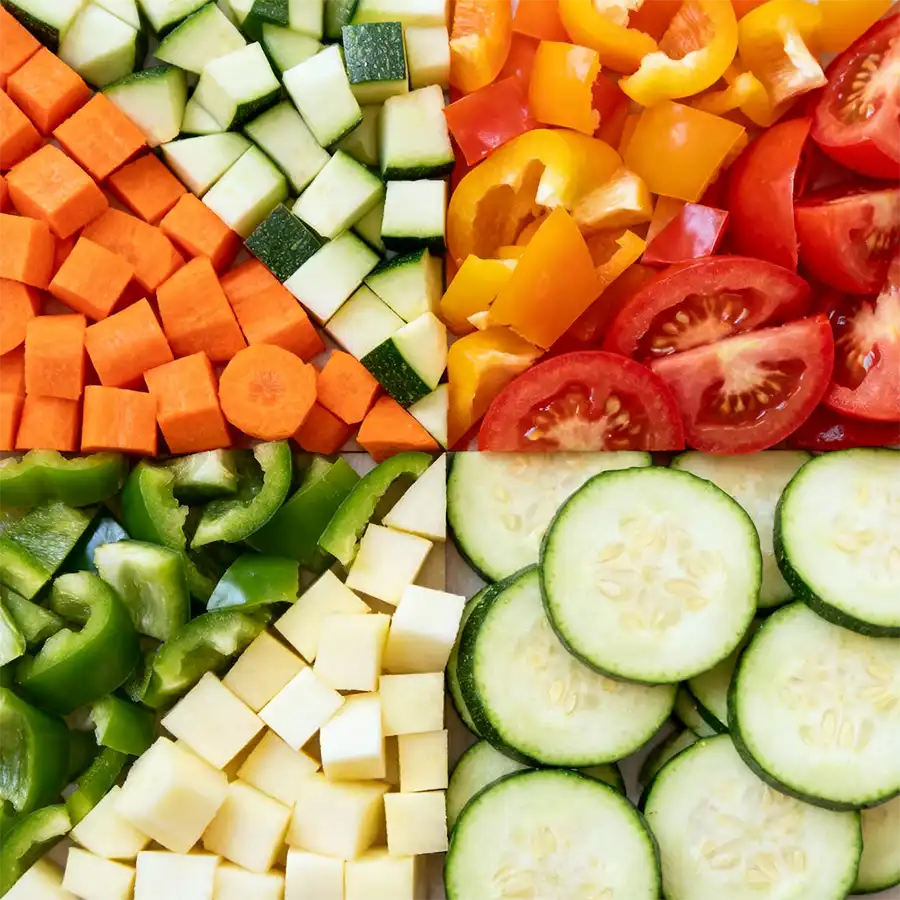
Cutting vegetables correctly is not just a preparatory stage in cooking, but a real art that can radically change the taste, appearance, and cooking time of a dish. How ingredients are cut determines how evenly they cook, how well their nutrients are preserved, and how aesthetically pleasing the dish looks when served.
Content
The importance of cutting vegetables correctly
Cutting vegetables correctly ensures even heat distribution, improves the appearance of dishes, and helps different types of vegetables cook at the same time. When all ingredients are the same shape and size, they cook simultaneously, preventing some vegetables from overcooking while others remain undercooked.
Basic types and techniques of cutting
Classic French techniques
Brunoise — very small cubes measuring 1-3 mm. This technique is ideal for sauces, soups, and side dishes, providing a delicate texture and quick preparation.
Julienne — thin strips 3-5 cm long and 1-2 mm thick. Vegetables cut into julienne strips are ideal for salads, wok dishes, or soups that require quick preparation.
Batonnet — sticks measuring 6 mm in width and 5-6 cm in length. Used for vegetable sticks or as a basis for other cutting techniques.
Chiffonade is a technique for leafy vegetables, where the leaves are rolled up and cut into thin strips. This adds elegance and sophistication to dishes.
Mirepoix — irregular medium-small cubes measuring 1-3 cm. Traditionally, it is a mixture of onions, carrots, and celery, which is used as a flavor base for soups, broths, and sauces.
Basic cutting shapes
Cubes of different sizes:
- Large cubes: 20×20×20 mm — for potatoes and berries
- Medium cubes: 8×8×8 mm — for carrots and potatoes in stewed dishes
- Small cubes: 3×3×3 mm — the finest cut for sauces and side dishes
Strips are long, thin strips 2-3 mm thick and 4-5 cm long. Ideal for cabbage in salads, potatoes for frying, and carrots for Asian dishes.
Brusochki are sticks with a square cross-section of 8×8 mm and a length of up to 5 cm. They are used for French fries and vegetable side dishes.
Rings — round slices 2-3 mm thick. A popular method for cucumbers, carrots, and tomatoes.
Cutting techniques for different vegetables

Onion
Onions are chopped differently for different dishes:
- Half rings — for pilaf and fried dishes
- Diced — for sauces and soups
- Straws — 1 mm thick for salads
Carrots
Carrots can be cut:
- Rings — for decorative design
- Straws — along the core for Asian dishes
- Slices — from cylinders 2.5-3 cm long
- Cubes — different sizes depending on the purpose
Potatoes
The most versatile vegetable for slicing:
- Strips — for deep frying (0.2×0.2 cm cross-section)
- Cubes — for frying (1×1 cm)
- Cubes — various sizes for soups
- Slices — 4-5 pieces from half a tuber
- Slices — 2-3 cm thick for baking
Cabbage
Traditional cutting methods:
- Straws — for salads and stewing
- Checkers — squares for soups
- Chopping — for pickling
Tools and equipment
Professional knives

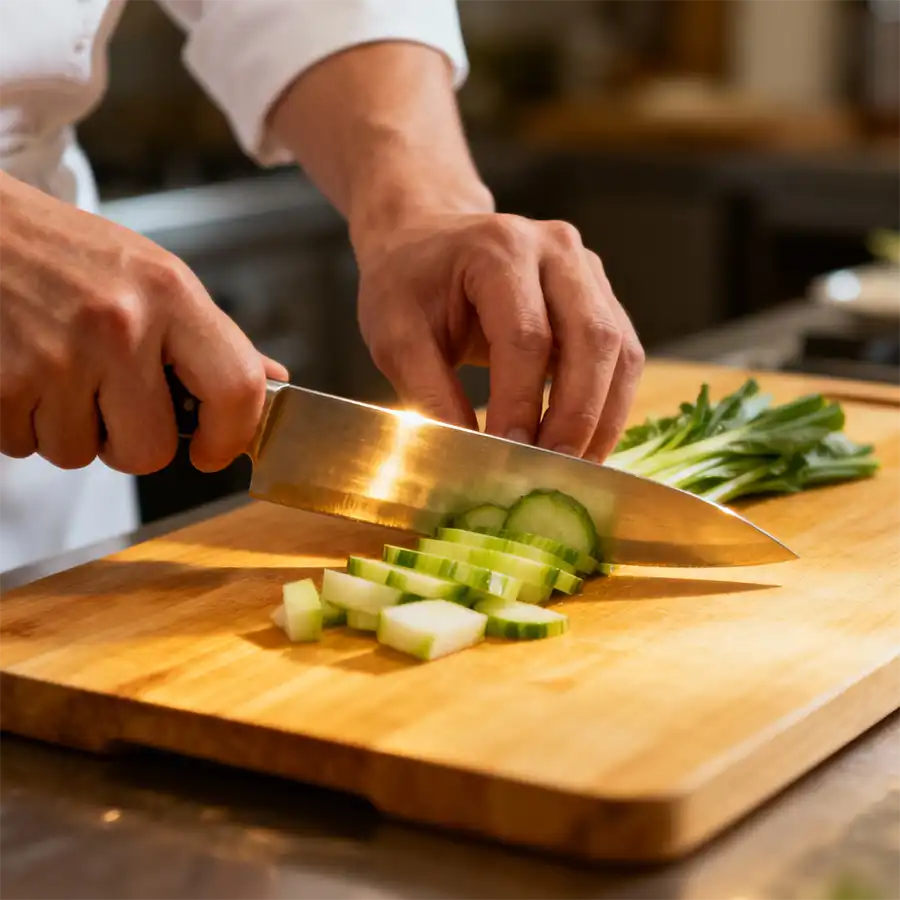
A chef’s knife is the main tool with a long, wide blade measuring 20-25 cm. Thanks to its curved blade, it can rock back and forth, allowing you to quickly chop vegetables.
A universal knife — medium length (15-20 cm) for everyday tasks.
A paring knife is a small knife for precise work with small vegetables and fruits.
Supporting tools
- Vegetable cutters with interchangeable discs for mechanical cutting
- Cutting boards marked “OS” for vegetables
- Mandolines for even slices
- Special knives for carving and decorative cutting
Safety rules when working with knives
Basic safety principles:
- Knife sharpness — a sharp knife is safer than a dull one because it requires less effort.
- Proper grip — hold the knife firmly by the handle, gripping it with your index finger near the blade.
- The “claw” technique — bend the fingers of the hand holding the vegetables so that the knuckles touch the knife.
- Cutting direction — always cut away from yourself, keeping the blade away from your body.
- Stable surface — place a damp towel under the cutting board
Knife storage:
- Use magnetic strips or special stands
- Never leave knives in the sink
- Store in a dust-free place
Secrets and tips from professionals – cutting vegetables
Workplace preparation:
- Ensure sufficient lighting
- Prepare clean dishes for raw materials and finished products.
- Place your tools conveniently and safely
- Keep products that go together together
Time optimization techniques:
- Mise en place — prepare all ingredients before you start cooking
- Chop all the vegetables at once for several dishes.
- Use the right knife for each task
- Keep your knives sharp — it saves time and effort.
Secrets of even cutting:
- Calibrate vegetables by size before cutting
- Create a flat surface by cutting off a small part of the vegetable.
- Use rocking motions for fast work
- Cut vegetables into equal pieces for even cooking.
How cutting vegetables affects the preparation of various dishes
Soups and broths
For soups, use evenly cut medium-sized pieces — 5-8 mm cubes or strips. This ensures even cooking and a nice appearance.
Salads
Julienne or thin cubes are best suited for salads. This type of cutting allows the dressing to better soak into the vegetables and creates a pleasant texture.
Stewed dishes
Use medium-sized cubes or small pieces. Large pieces may not cook through, while small pieces will boil down to a puree-like consistency.
Wok and quick frying
Julienne and thin strips are the ideal choice. Vegetables cook quickly and remain crisp.
Pilaf
Cut the carrots into long strips and the onions into half-rings. This not only improves the taste, but also gives the dish an authentic look.
The most common mistakes and how to avoid them
Errors in cutting technique:
- Uneven cutting — leads to uneven cooking
- The wrong choice of knife makes the job harder and reduces the quality of the cut.
- Poor preparation of ingredients — uncalibrated vegetables are difficult to cut evenly
- Rushing when cutting leads to injuries and poor results.
Mistakes in preparation:
- Removing the peel unnecessarily leads to a loss of nutrients.
- Mixing different types of vegetables without taking into account cooking time
- Using metal cookware without parchment paper for baking
Developing cutting skills
Exercises for beginners:
- Start with simple shapes — cubes and straws
- Practice on soft vegetables (cucumbers, tomatoes)
- Gradually move on to more complex techniques
- Develop attentiveness during the process
Practical tips:
- Set aside time for practice every day
- Experiment with different knives
- Watch videos of professional chefs
- Don’t rush — quality is more important than speed
FAQ: frequently asked questions about cutting vegetables
Why is it important to cut vegetables correctly?
Proper cutting ensures even cooking, improves the appearance of the dish, and allows the flavors of the ingredients to fully develop.
How to choose the right knife for cutting?
A chef’s knife with a length of 20-25 cm is suitable for most tasks. For precision work, use a paring knife, and for bread, use a serrated knife.
How often should knives be sharpened?
The sharpness of the knife depends on how often it is used. Check the sharpness regularly — the knife should cut paper easily.
What should you do if the vegetables are cut unevenly?
Large pieces can be chopped further, while smaller pieces can be used for other dishes or sauces.
How to learn to chop vegetables quickly?
Start slowly, focusing on quality. Speed will come with practice. Use rocking motions with the knife.
Can all the vegetables be chopped in advance?
Some vegetables (potatoes, apples) darken when exposed to air. Store them in water with lemon juice or cut them just before cooking.
How to store chopped vegetables?
In the refrigerator in airtight containers for no more than 2-3 days. Some vegetables are best cut just before use.
Do all vegetables need to be peeled?
No, in most cases, the skin contains beneficial substances. It is sufficient to wash the vegetables thoroughly.
Mastering vegetable cutting comes with experience and practice. By following the right techniques, using quality tools, and keeping safety in mind, you can significantly improve the quality of your culinary creations. Proper cutting is the first step toward professional cooking, opening up endless possibilities for culinary creativity.