The right choice of fish is not just a guarantee of a delicious meal, but an important step towards healthy eating. Quality fish contains valuable proteins, omega-3 fatty acids, vitamins, and minerals, essential for the functioning of the heart, joints, skin, and immunity. However, only fresh and properly selected fish brings maximum benefits. Below is a detailed instruction on what to pay attention to when purchasing, what signs to pay attention to, how to view the fish to choose it for different dishes, as well as useful lifehacks for buyers.
Main criteria for choosing fresh fish
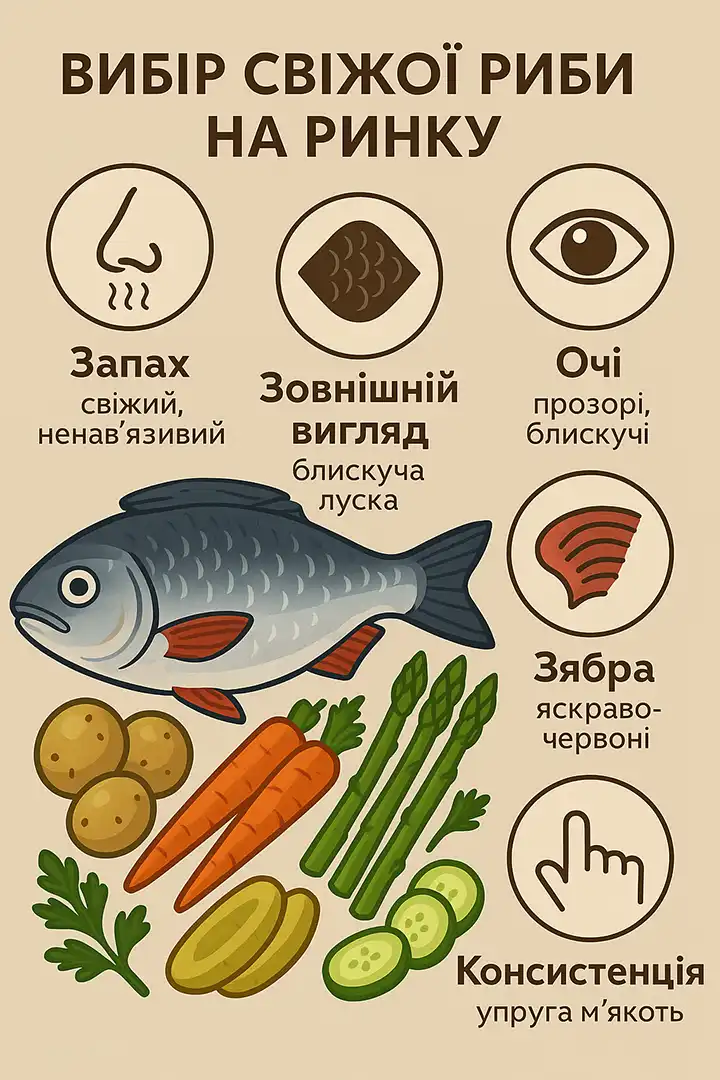
1. Freshness
- Fresh seafood should smell of the sea, while fish from rivers should smell of clean water, with a slight river aroma.
- Fish that smells sour, rancid, stale, or fishy is a sign of a spoiled product. Such fish can be unsafe for health.
2. External appearance and sheen
- Fresh fish should be shiny, smooth, and have a firm texture, without any blemishes or dryness.
- If the skin appears slightly faded or looks dull, the fish is not fresh.
- The skin should be moist, with natural shine, without stains, breaks, or slits.
3. Eyes
- In fresh fish, the eyes are opaque, clear, shiny, with a distinctly dark pupil.
- Cloudy, sunken, dry, or murky eyes are signs of prolonged storage.
4. Gills
- Gills should be bright red or pink, without slits or unpleasant storage smell.
- Dark-red, brown, gray or black gills, as well as slimy patches are signals that the fish is spoiled.
5. Consistency of the flesh
- Meat should be firm and shiny; when pressed, it quickly returns to its original shape.
- Soft, pale, with blemishes or discolored spots — a sign of old fish.
6. Fish and fillets
- Fish and fillets should be whole, moist, not slimy, and without any residues.
Choosing Fresh Fish: What to Pay Attention To
- Fresh fish should be firm, without ice, frozen skin, or waterlogged spots.
- Ice on the fish is normal, as long as it is thin and transparent (excess should be avoided). A thick layer of ice or snow indicates an attempt to cover defects or water weight loss.
- Do not buy fish with bruises, spots, yellowing, or external stains.
- The fillet should be a uniform color, without dark or yellowish stains.
- If the packaging is damaged or if the fish shows crystal ice — it is a product that has been thawed and refrozen, which negatively affects quality and safety.
Secrets and Tips for Purchasing
- Do not buy fish from open displays, especially in supermarkets. The best option is stores with cold storage or specialized fish counters.
- It’s better to buy fish on the day of preparation or in advance. Freshness is the main criterion for quality and safety.
- Check the fish’s origin. Wild varieties, caught in their natural environment, are usually safer and firmer than farm-raised ones. However, farmed fish may be smaller and contain fewer harmful substances, provided the producer adheres to standards.
- Avoid fish that appears slimy or has a suspicious appearance at a low price.
- When buying fish, pay attention to the freshness of the fillets and the absence of foreign odors. The fillet must be whole, not broken, with no stains or slime.
- Fish should be stored in water at home: fresh fish is firm, whereas stale fish becomes soft.
- Do not buy fish with overly bright colors (especially salmon, trout): this may be a result of artificial coloring.
- Ask the seller about the catch date, storage conditions, and quality certification.
- Pay attention to the seasonality: some fish are caught only during specific times of the year.
Marine or freshwater: which one to choose?
| Criterion | Marine fish | Freshwater fish |
|---|---|---|
| Omega-3 | More | Less |
| Iodine | More | Less |
| Environmental impact | Good | Lesser for ponds |
| Parasite risk | Less | Higher |
| Caloric content | Higher (fatty species) | Usually lower |
| Accessibility | Usually more expensive | More accessible |
Sea fish (salmon, mackerel, trout, hake, dorado, seabass) can grow larger than omega-3, but often is more expensive.
River fish (perch, pike, carp, pike-perch, bream) tends to be cheaper, can grow larger than freshwater, but requires additional thermal processing through a quick rise of temperature.
How to recognize a poor-quality processing
- Some sellers may offer stale fish with additives, preservatives, coloring agents or flavor enhancers.
- Do not buy fish with a variety of strange packaging colors, especially bright colors or labeled with the term “freshness” after processing.
- If the fish has a mushy, slimy texture, has dark spots, or is surrounded by odd packaging — it signifies low-quality products.
Tips for safe purchasing
- Choose fish from closed refrigerators or with ice, not from open display cases.
- Buy from certified vendors who comply with sanitary standards.
- Do not hesitate to inquire about the catch date, storage conditions and origin of the fish.
- Prefer whole fish that can be examined from all sides, rather than just fillets.
Which fish to choose for different dishes
- For frying: dorado, seabass, salmon, perch, pike, hake.
- For grilling: pike-perch, trout, mintai, catfish.
- For baking: carp, catfish, crucian carp, mackerel.
- For soups: perch, pike, trout, mintai, oselenec (for broths).
- For dietary dishes: hake, mackerel, trout, cod, dorado, seabass.
Tips for Choosing Fish
- If you buy fish from the market, choose a larger one—its flesh is fresher.
- To check the freshness of a fish, press down on the flesh: fresh fish springs back quickly.
- If you buy fillets, choose vacuum-packed ones with minimum preservatives and no added fillers.
- Frozen fish is better thawed gradually—start in the refrigerator, then at room temperature, to preserve its texture.
- For children and people with allergies, choose fish with a minimal number of bones (for example, hake, trout, fillet of salmon).
Conclusion
The right choice of fish is a matter of attention to details: freshness, appearance, color, consistency, and storage conditions. Don’t rush, retail product reviews are not received through marketing tricks. Fresh fish is not only delicious but also beneficial for your health!
Remember: it’s better to buy less, but high-quality fish than to risk your health for a seemingly economical option. Choose wisely, and your dish will be not only tasty but also maximally beneficial!