Making your own wine at home is an ancient art that combines tradition with modern technology. Successful winemaking depends on choosing the right raw materials, following the technology, and creating optimal conditions for each stage of the process. In this detailed guide, we will cover all aspects of home winemaking, from choosing grapes to bottling the finished drink.
Content
The history of home winemaking
Wine production has existed for over 8,000 years and is one of the oldest crafts of mankind. Archaeological findings confirm that grape wine was produced in Ancient Egypt, Mesopotamia, and the Caucasus. In Ukraine, winemaking traditions date back to the time of the Scythians, when grapes were actively cultivated in the territory of modern Kherson and Crimea.
Home winemaking developed particularly in the Middle Ages, when monasteries became centers of wine culture. Each region developed its own technologies and recipes, which led to an incredible diversity of wine traditions.
Scientific foundations of winemaking
Biochemistry of the process
Wine production is based on complex biochemical processes, the main one being alcoholic fermentation. This process is carried out by Saccharomyces yeast, which converts grape sugars (glucose and fructose) into ethyl alcohol and carbon dioxide.
Chemical formula of the process:
C₆H₁₂O₆ → 2C₂H₅OH + 2CO₂
In addition to the main alcoholic fermentation, numerous additional reactions take place in wine, which form the bouquet, taste, and aroma of the drink. This includes the formation of esters, aldehydes, ketones, and other organic compounds.
The role of tannins and antioxidants
Tannins are polyphenolic compounds that give wine its structure, astringency, and aging potential. They are concentrated mainly in the skin and seeds of grapes. Red wines contain significantly more tannins due to prolonged contact with the pulp during production.
Antioxidants, especially resveratrol, make wine not only delicious but also a healthy drink when consumed in moderation. These substances protect the body from free radicals and have cardioprotective properties.
Detailed grape selection: in-depth analysis
Climate and terroir
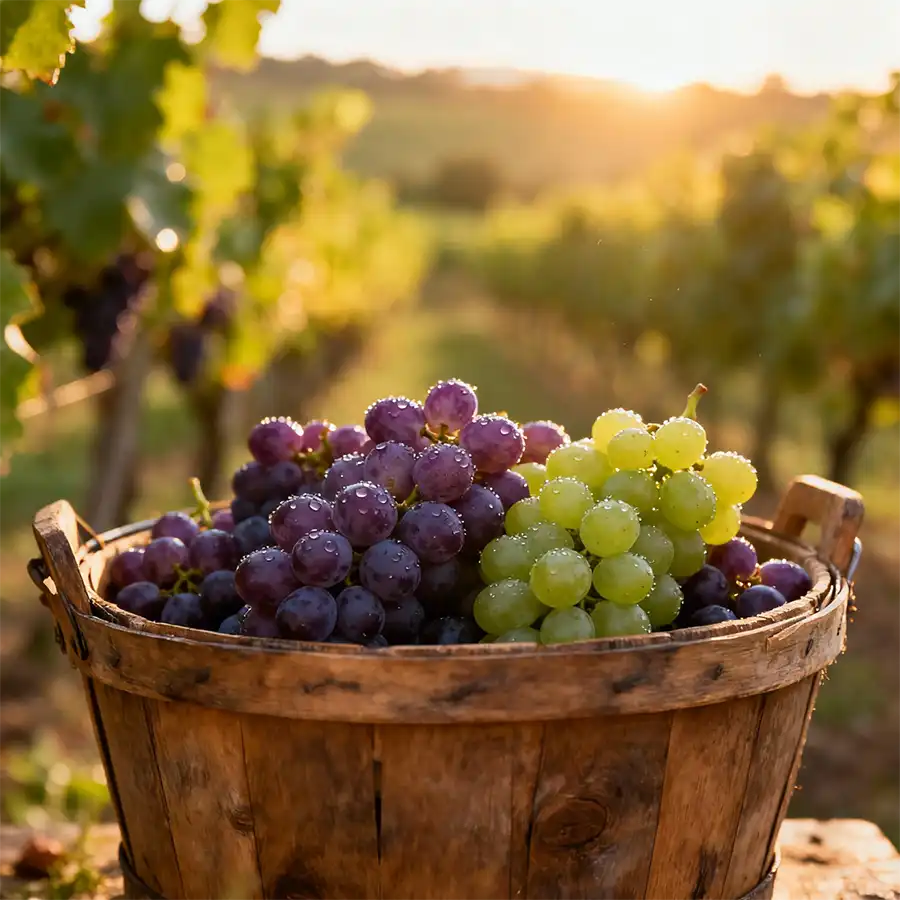
The quality of grapes depends not only on the variety, but also on the growing conditions—the terroir. This term includes the climate, soil, relief, and microclimate of a particular area. In Ukraine, the best conditions for viticulture are found in the Odesa, Mykolaiv, Kherson, and Zakarpattia regions.
Optimal climatic conditions:
- Average temperature during the growing season: 15-20°C
- Number of sunny days: at least 120-130
- Precipitation: 400-600 mm per year, evenly distributed
- No frosts during critical periods
Detailed classification of varieties for home wine making
Autochthonous Ukrainian varieties:
- Odessa Black: produces rich red wines with fruity notes
- Steppic: white technical variety, drought-resistant
- Worthy: a red variety with balanced acidity
- Magarach’s firstborn: an early-ripening white variety
International varieties adapted to Ukrainian conditions:
Red varieties:
- Cabernet Sauvignon: a classic variety for structured red wines
- Merlot: a milder variety, well adapted to different conditions
- Pinot Noir: capricious, but produces elegant wines
- Saperavi: a Georgian variety with a high concentration of pigments
- Isabella: a hybrid variety, undemanding but with a specific aroma
White varieties:
- Chardonnay: a versatile variety for different styles of white wine
- Riesling: an aromatic variety with high acidity
- Sauvignon Blanc: a variety with pronounced herbal notes
- Gewürztraminer: a highly aromatic variety with spicy notes
- Fetiaska white: a Romanian variety, common in Ukraine
Criteria for collection and quality assessment
Ripeness indicators:
- Sugar content: 18-25% for white varieties, 20-26% for red varieties
- Acidity: 6-9 g/l in terms of tartaric acid
- pH of wort: 3.0-3.8 depending on variety
- Phenolic ripeness: important for red varieties
Organoleptic evaluation:
- The color of the berries is uniform, characteristic of the variety.
- The skin is easily separated from the flesh.
- The seeds are brown in color and easily separated.
- Sweet taste, no green aftertaste
Advanced equipment and tools for home winemaking
Professional equipment for home winemaking
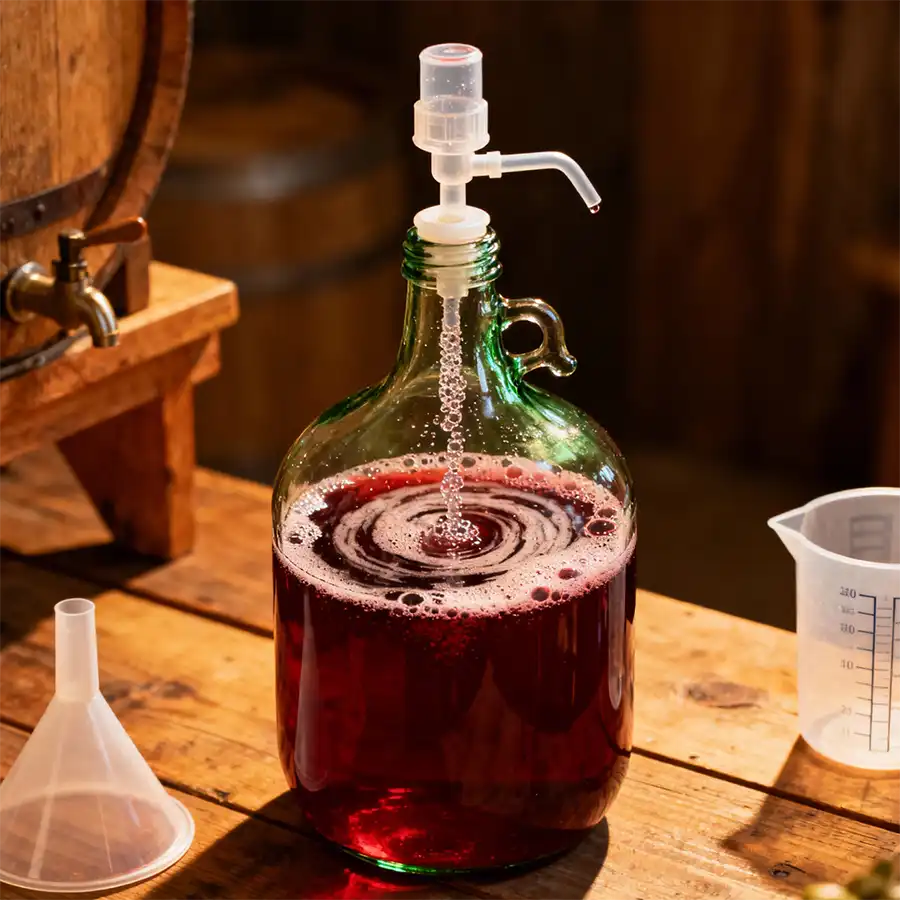
Crusher-separator: mechanizes the process of crushing berries and separating seeds. Significantly improves the quality of the mash and reduces labor costs.
Hydraulic press: ensures gentle juice extraction without damaging the seeds. Allows you to get more juice of better quality.
Hydrometer and refractometer: for accurate measurement of sugar content in wort and control of the fermentation process.
pH meter: critical for controlling acidity at all stages of production.
Specialized supplements and preparations
Wine yeast: different strains for different wine styles
- EC-1118 strain: versatile, withstands high alcohol content
- Strain D-47: for elegant white wines with preserved aromas
- RC-212 strain: for red wines with intense color
Enzymes: accelerate juice extraction and wine clarification
- Pectinase: breaks down pectin substances
- Cellulase: improves juice yield
Preservatives and antioxidants:
- Potassium metabisulfite: prevents oxidation and the development of pathogenic microflora
- Ascorbic acid: a natural antioxidant
Detailed recipe for homemade wine with variations
Basic recipe for dry red wine
Ingredients per 100 kg of grapes:
- Red grapes: 100 kg
- Wine yeast: 20-30 g
- Potassium metabisulfite: 10-15 g
- Sugar (if needed): 2-5 kg
Technological variations
Classic technology (red wine):
- Crushing with partial removal of combs
- Maceration on the skins for 5-7 days at 25-28°C
- Alcoholic fermentation with regular stirring
- Pressing and malolactic fermentation
- Aging and maturation
White technology for red grapes:
- Fast crushing and pressing
- Lighting of wort
- Fermentation at low temperatures of 16-18°C
- The result is a pink or light red wine.
White wine technology:
- Crushing without maceration
- Rapid pressing and lightening
- Cold fermentation at 12-16°C
- Storage in an inert environment
Detailed preparation steps – homemade wine
Preparatory stage
Sanitary treatment:
All surfaces that will come into contact with grapes and must are treated with a solution of potassium metabisulfite (5 g per 10 l of water) or special disinfectants for winemaking.
Preparation of yeast culture:
- Dissolve the yeast in warm water (35-40°C) with a small amount of sugar.
- Leave for 15-20 minutes until foam appears.
- Gradually add a little wort to adapt
Primary processing
Crushing and comb separation:
Modern technology involves removing 80-100% of combs, as they:
- Absorb alcohol and extractive substances
- Give wines herbal notes
- Complicating pressing
Sulfitation:
Addition of SO₂ in the form of potassium metabisulfite (50-100 mg/L) for:
- Suppression of wild yeast and bacteria
- Protection against oxidation
- Selective selection of wine yeasts
Maceration and extraction
For red wines:
The duration of maceration determines the intensity of color and extractivity:
- Light wines: 3-5 days
- Medium wines: 7-10 days
- Full-bodied wines: 15-21 days
Maceration temperature control:
- Start: 20-22°C for gentle extraction
- Peak fermentation: 28-30°C for maximum extraction
- Completion: gradual decrease to 20°C
Repumping (pumping):
Daily pumping of the wort from bottom to top ensures:
- Uniform extraction of coloring substances
- Proper aeration of yeast
- Prevention of acetic acid bacteria growth
In-depth control of the fermentation process
Phases of alcoholic fermentation
Lag phase (0-24 hours):
Yeast adapts to the new environment. There are no visible signs of fermentation. It is important to ensure optimal temperature and aeration.
Exponential phase (1-5 days):
Intensive yeast reproduction and active fermentation. The temperature rises and a lot of CO₂ is released. Temperature control is required.
Stationary phase (5-14 days): Fermentation
slows down due to a decrease in sugar and the accumulation of alcohol. Wine clarification begins.
Die-off phase (14+ days):
The yeast gradually dies off, forming a sediment. The wine gradually clears and stabilizes.
Quality control during fermentation
Daily measurements:
- Temperature: use of digital thermometers
- Density: with a hydrometer or refractometer
- Organoleptic evaluation: smell, color, taste
Possible problems and their solutions:
Slow fermentation:
- Reasons: low temperature, lack of nutrients for yeast
- Solution: increase the temperature, add yeast nutrient
Fermentation stalling:
- Reasons: high alcohol content, lack of yeast, extreme temperatures
- Solution: add fresh yeast, adjust the temperature
Wild yeast and bacteria:
- Signs: unpleasant odor, cloudiness, carbonation
- Solution: sulfitation, interruption with filtration
Complex technological techniques
Malolactic fermentation
This process converts malic acid into lactic acid using special bacteria. The result:
- Reduction in acidity by 1-3 g/l
- Softer, rounder taste
- Additional microbiological stability
Terms and conditions:
- Temperature: 18-22°C
- pH: above 3.2
- Low SO₂ content
- Addition of lactic acid bacteria cultures
Racking (lifting sediment)
Technique for stirring fine yeast sediment for:
- Enriching wine with aromatic compounds
- Improving texture
- Prevention of oxidation
Performed weekly for 2-4 months after the completion of primary fermentation.
Blending
The art of blending different wines to achieve the best result:
- Varietal blending: mixing different varieties
- Territorial: from different areas
- Yield: different harvest years
Principles of blending:
- Initially, trial mixing in small volumes
- Organoleptic evaluation after 2-3 weeks
- Chemical analysis of the blend
- Production blending
Aging and maturation
Physical and chemical processes of aging
Esterification:
The formation of complex esters between alcohols and acids, which shapes the bouquet of wine.
Polymerization of tannins:
Tannin molecules combine into larger complexes, making the wine smoother.
Oxidation-reduction processes:
Controlled oxidation creates complex aromas and flavors.
Choosing containers for aging
Glass containers:
- Advantages: inertness, ease of cleaning, process control
- Disadvantages: lack of microoxygenation
Oak barrels:
- Advantages: micro-oxygenation, imparting tannins and oak aromas
- Disadvantages: high cost, difficult to maintain
Stainless steel:
- Advantages: inertness, ease of cleaning, temperature control
- Use: for fresh white and young red wines
Exposure modes
Cold storage (8-12°C):
- For white wines and light reds
- Preserves freshness and fruitiness
- Minimal oxidation processes
Temperature stability (14-18°C):
- For structured red wines
- Accelerates ripening
- Activates complex biochemical processes
Advanced lighting and stabilization techniques
Natural lighting methods
Gravity lighting:
The gentlest method, taking 2-6 months depending on conditions.
Cold stabilization:
Cooling the wine to -4°C for 2-3 weeks to precipitate tartrates.
Physical methods
Filtering:
- Coarse filtration: through diatomite or perlite
- Fine filtration: through 0.45 µm membrane filters
- Sterilizing: through 0.22 μm filters
Centrifugation: A
rapid method of separating sediment for large volumes.
Chemical brighteners
Bentonite: A
clay mineral for removing protein cloudiness.
Egg white: A
traditional clarifier for red wines, binding excess tannins.
Gelatin:
Effective for removing phenolic compounds in white wines.
Activated charcoal:
Removes unwanted flavors and colors (use with caution).
Quality control and tasting
Organoleptic analysis
Appearance:
- Transparency: from crystal clear to slightly cloudy
- Color: corresponding to the variety and age
- Brilliance: a sign of wine health
Aroma:
- Primary aromas: varietal characteristics of grapes
- Secondary aromas: from fermentation and winemaking
- Tertiary aromas: from aging and maturation
Taste:
- Balance between acidity, sweetness, tannin, and alcohol content
- Intensity and duration of taste
- Harmony of the overall impression
Common defects and their identification
Cork taint:
Smell of damp cardboard due to contaminated cork. The wine is unfit for consumption.
Acetic fermentation: A
sharp vinegar smell due to the development of acetic bacteria.
Hydrogen sulfide:
Smell of rotten eggs due to improper fermentation or storage.
Mouse tone: A
specific unpleasant odor caused by bacterial contamination.
Packaging and storage of finished wine
Preparation for bottling
Final stabilization:
- Cold stabilization at -4°C
- Addition of preservatives (SO₂)
- Final filtration
Calculation of preservatives:
- Free SO₂: 25-35 mg/L for reds, 35-50 mg/L for whites
- Total SO₂: no more than 200 mg/l
Bottling technology
Sanitary training:
- Washing bottles with hot alkaline solution
- Disinfection with metabisulfite solution
- Rinsing with boiled water
Bottling process:
- Wine temperature: 12-16°C
- Minimal aeration during bottling
- Filling at the bottom of the neck
Selection of sealing materials
Natural cork:
- The best choice for long-term storage
- Provides microoxygenation
- Cost is higher than alternatives
Agglomerated crusts:
- A compromise between price and quality
- Suitable for medium-term storage wines
Synthetic corks:
- No foreign flavors
- Ideal for young wines
- Do not provide microoxygenation
Screw caps:
- The best protection against oxidation
- Keeping white wines fresh
- Ease of use
Classification of wines by style
By alcohol and sugar content
Dry wines (up to 4 g/l sugar):
- Complete fermentation of natural sugars
- Alcohol content 11-14%
- The most common type of table wine
Semi-dry wines (4-12 g/l):
- Light sweetness that does not dominate
- Balanced taste
- Suitable for beginners in winemaking
Semi-sweet wines (12-45 g/l):
- Noticeable but not excessive sweetness
- Need stabilization against re-fermentation
- Popular among a wide range of consumers
Sweet wines (over 45 g/l):
- Dessert and liqueur wines
- Complex manufacturing technology
- High storage potential
By manufacturing method
Still wines:
Without natural or artificial CO₂ enrichment.
Sparkling wines:
- The classic method: secondary fermentation in the bottle
- Sharma method: fermentation in pressure-resistant acratophores
- Carbonation: artificial saturation with carbon dioxide
Fortified wines:
Adding alcohol to increase strength and stability.
Seasonality and planning of wine production
Winemaker’s calendar
September-October:
- Harvesting and processing
- The beginning of alcoholic fermentation
- Maceration temperature control
November-December:
- Completion of primary fermentation
- First removal from the sediment
- Malolactic fermentation for red wines
January-February:
- Second removal from the sediment
- Cold stabilization
- Start of aging
March-May:
- Third removal from the sediment
- Tasting control
- Preparation for blending
June-August:
- Final stabilization
- Filtration and bottling
- Preparing for the new harvest
Room planning
Production premises:
- Temperature: 15-25°C
- Ventilation for CO₂ removal
- Protection from light
Composition of the blend:
- Constant temperature: 10-15°C
- Humidity: 65-80%
- No vibrations
Economic aspects of home winemaking
Cost calculation
Initial investment:
- Basic equipment: 5,000-15,000 UAH
- Specialized devices: 3000-8000 UAH
- Raw materials and supplies: 2,000-5,000 UAH per batch
Current expenses (per 100 liters of wine):
- Grapes: 2000-4000 UAH
- Supporting materials: 500-800 UAH
- Electricity and water: 200-400 UAH
- Bottles and corks: 1500-2500 UAH
Economic efficiency
When organized correctly, home winemaking allows you to obtain high-quality wine at a cost of 80-150 UAH per 0.75 liter bottle, which is significantly cheaper than similar store-bought wine.
Legal aspects
Legislation of Ukraine
The production of wine for personal consumption is permitted without a license, subject to the following conditions:
- Production volume: up to 200 liters per person per year
- Prohibition on sales without appropriate documentation
- Use only for personal needs and treats
Mandatory requirements
- Compliance with sanitary standards
- Use of permitted additives
- Keeping records for tax authorities for large volumes
Extended FAQ
Technical issues
Can different grape varieties be blended?
Yes, blending (blending) often improves the quality of wine. The main thing is to stick to the proportions and take into account the compatibility of varieties in terms of taste characteristics.
How does weather affect grape quality?
Weather conditions are critically important. Sunny summers increase sugar content, moderate rainfall ensures berry development, and cool nights preserve acidity.
Is it necessary to add yeast if fermentation has started naturally?
Natural fermentation is unpredictable. It is better to add cultured yeast for guaranteed results and process control.
How many times should wine be racked?
At least 3-4 times: one month after fermentation is complete, after 3 months, after 6 months, and before bottling.
Problems and their solutions
The wine has an unpleasant smell of hydrogen sulfide:
Add copper sulfate (0.1-0.2 g/l), stir, and remove from the sediment after a week. Prevention: avoid contact with metal.
The wine is too acidic:
You can perform malolactic fermentation or carefully add potassium carbonate (no more than 2 g/l).
The wine has become cloudy after bottling:
Probably insufficient stabilization. Return to the bottle, clarify with bentonite, and filter again.
How to prevent secondary fermentation in the bottle?
Ensure complete stability: completion of all types of fermentation, sufficient SO₂ levels, sterile bottling.
Storage and consumption
At what temperature should homemade wine be served?
White wines: 8-12°C, light reds: 12-14°C, full-bodied reds: 16-18°C.
How long can an opened bottle be stored?
White wines: 2-3 days in the refrigerator, red wines: 3-5 days at room temperature with minimal air exposure.
Does homemade wine improve with age?
It depends on the style and quality of production. Light young wines are best consumed within a year, while structured reds can improve over 2-5 years.
Conclusions and recommendations
Home winemaking is a complex but exciting activity that combines science, art, and craftsmanship. Success depends on a systematic approach, high-quality raw materials, and adherence to technology at every stage.
Key principles of successful winemaking:
- The quality of raw materials is the basis of good wine. Invest time in the right choice and preparation of grapes.
- Cleanliness and sterility are the key to healthy fermentation and the absence of defects.
- Process control – regular monitoring of temperature, acidity, and fermentation progress.
- Patience – wine needs time to develop its taste and bouquet.
- Continuous learning – each batch provides new experiences and opportunities for improvement.
Beginners are advised to start with simple recipes and gradually increase the complexity of the technique. Keep detailed records of each stage—this will allow you to analyze mistakes and reproduce successful results.
Remember that winemaking is an art that is perfected over many years. Even experienced winemakers are constantly experimenting and discovering new facets of this ancient craft. The main thing is to enjoy the process and not be afraid to experiment within reasonable limits.
Homemade wine, made with love and expertise, will always be special—it carries a piece of your soul and the uniqueness of your terroir. It is not just a drink, but the embodiment of tradition, craftsmanship, and a creative approach to one of the oldest human activities.