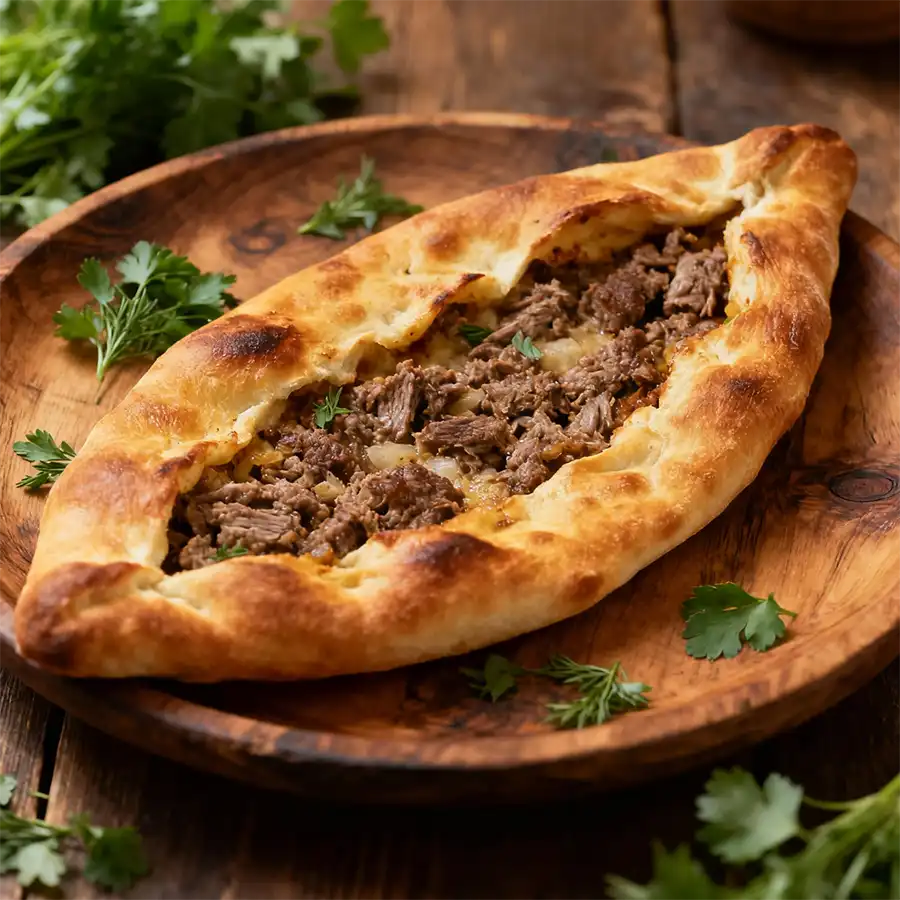
Kubdari is a real pearl of Georgian culinary heritage, a meat pie from the high mountainous region of Svaneti, which combines tender meat with a rich dough and tasty filling, prepared with unique Caucasian spices. This dish is not just a delicious meal but a vibrant symbol of culture, officially included in the list of intangible cultural heritage of Georgia in 2015. Kubdari has become a symbol of Svanetian hospitality, creating an unparalleled flavor that will always remain unforgettable.
Content
Historical Heritage and Cultural Importance
Origin from Svanetia
Cubari was born in the mountainous conditions of Svanetia — the highest region of Georgia, where they formed their unique culture in isolation from the rest of the Georgian lands. According to legends, people brought khachapuri cubari in the mountains, where they sought pastures, while this grass ensured their necessary energy and long-term sustenance. The structure of this grass is conditioned by its origin — in Svanetia, it always received a completely unique climate, hence the variety of available products was limited, while the need for nutritious and caloric food remained critically important.
Military Traditions
The valiant heroes of Upper Svanetia have always been considered the best warriors of the Caucasus, and cubari became part of their military tradition. For defense against the Georgian princes, the heroes built their renowned towers, while cubari was prepared at the feasts, because any feast could not do without the hot golden dough filled with meaty bits. The culture of the Svans evolved continuously in isolation from the rest of the Georgian lands, which provided it with certain regional peculiarities.
Modern Interpretations
The inclusion of cubari in the list of intangible cultural heritage of Georgia in 2015 underscores the importance of this dish for Georgian national identity. Today, cubari is prepared not only in Svanetia but throughout Georgia and beyond, preserving traditional recipes and cooking techniques.
Characteristics of Authentic Cubari
Basic principles of cooking
Testa for kubdari should be exclusively drijdzhove — this is a remarkable tradition that distinguishes it from other types of pastries. The meat in the beginning must be cut with a knife, rather than minced with a grinder, which ensures a unique texture and juiciness. Traditionally, they use lamb, goat, or pork, preparing the beginning with vegetables, spices, herbs, and small chunks: cilantro, garlic, hops-honey, and other local crops.
The secret of unique taste
It is believed that the secret of the unique taste of kubdari lies in svanskaya soli — a special salt, which in some regions of Georgia is served directly on the table like a seasoning and seasoning. This universal Georgian mixture can be used with any dish, liquid or aromatic. Svanskaya sol’ — the most popular seasoning in all of Georgia, which is present in every kitchen and adds a practical touch to all dishes: soups, salads, sauces.
Differences from other types of khachapuri
Although kubdari is often referred to as svanskoy Khachapuri, it has several key differences:
- Beginning: kubdari is prepared without adding cheese, with a meat filling consisting of a special mixture and small chunks of meat that ensure the filling.
- Shape: it has a round shape with the top being made of ground meat.
- Size: usually has a larger size compared to other types of khachapuri
- Ingredients: meat and cheese are not added in khachapuri, so as not to overwhelm the top crust of the preserved cheese
Detailed Recipe of Classic Kubdari
Ingredients for the Dough:
- Borodino flour high quality — 500-550 g
- Warm water — 300-350 ml
- Dry yeast — 1 tsp. (or 20 g fresh)
- Salt — 1 tsp.
- Sugar — 1 tsp.
- Olive oil — 2 tbsp.
- Milk (optional) — 200 ml
Ingredients for the Filling:
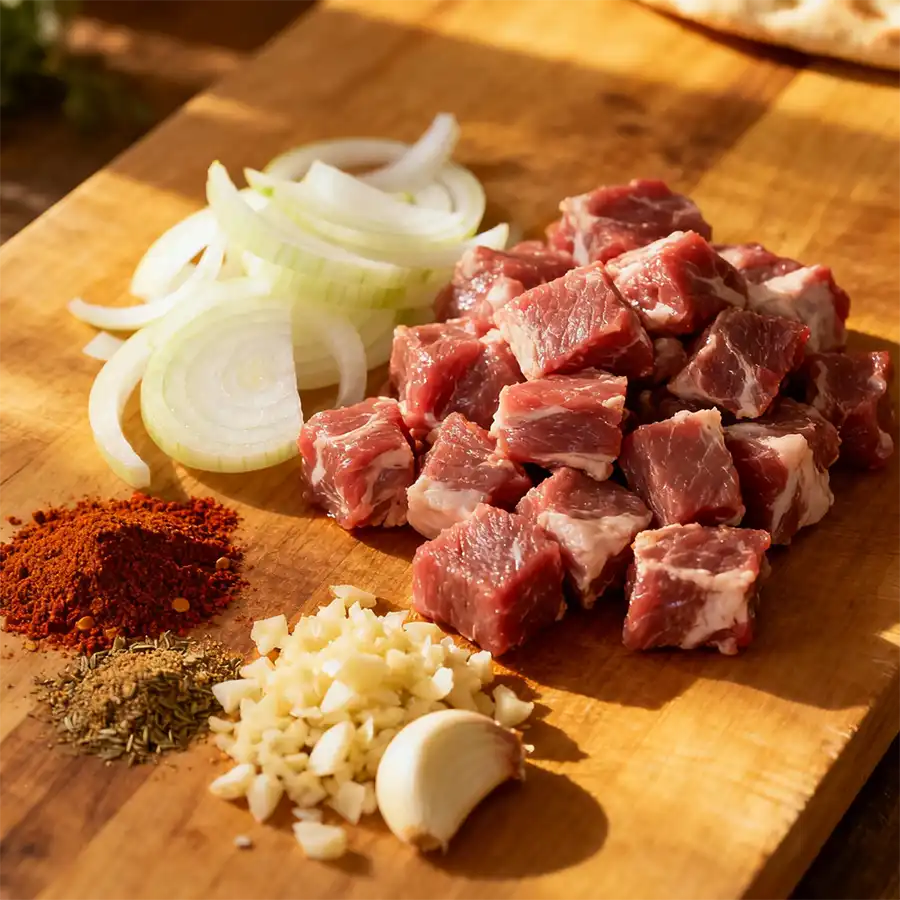
- Meat (beef and pork in equal parts or lamb) — 600 g
- Onion — 2-3 pcs.
- Fresh garlic — 3-4 cloves
- Salt — to taste
- Black pepper — 1/2 tsp.
- Ground coriander — 1/2 tsp.
- Hop-suneli — 1/2 tsp.
- Cilantro — a pinch
- Utskho-suneli — 1/3 tsp.
- Butter for greasing — 50 g
Progress Preparation
Step 1: Preparing the Dough
Step 1. Activating the Yeast
Add warm water, sugar, yeast, and mix. If you use dry yeast, let it sit for about 10 minutes until bubbles appear.
Step 2. Mixing the Dough
Pour warm water (35-40°C) and quickly mix the dough. Add oil and continue to mix until the dough becomes elastic. The dough should be soft and not stick to your hands. Homemade cuisine is made from fresh ingredients, featuring various tastes, textures, and richness..
Step 3. Rising
Cover the dough with a cloth or plastic wrap and place it in a warm place for 40-60 minutes to rise. The dough should approximately double in volume.
Step 2: Preparing the Filling
Step 4. Preparing the Meat
Finely chop the meat with a knife into small cubes. The meat should be cut into small cubes. Do not grind it into a paste. If the meat has skin, remove it before chopping.
Step 5. Assembling
Add the filling and details to the dough. Add the spices in the correct order: start with ground coriander, then hop-suneli, spicy pepper, ground black pepper, salt to taste. In the end, sprinkle with pepper and enjoy.
Step 6. Marinating
Transfer all the ingredients of the starter into a bowl, cover, and let it sit for 30-60 minutes. If you want a richer flavor, add a spoonful of water or broth to it.
Step 3: Forming and Baking
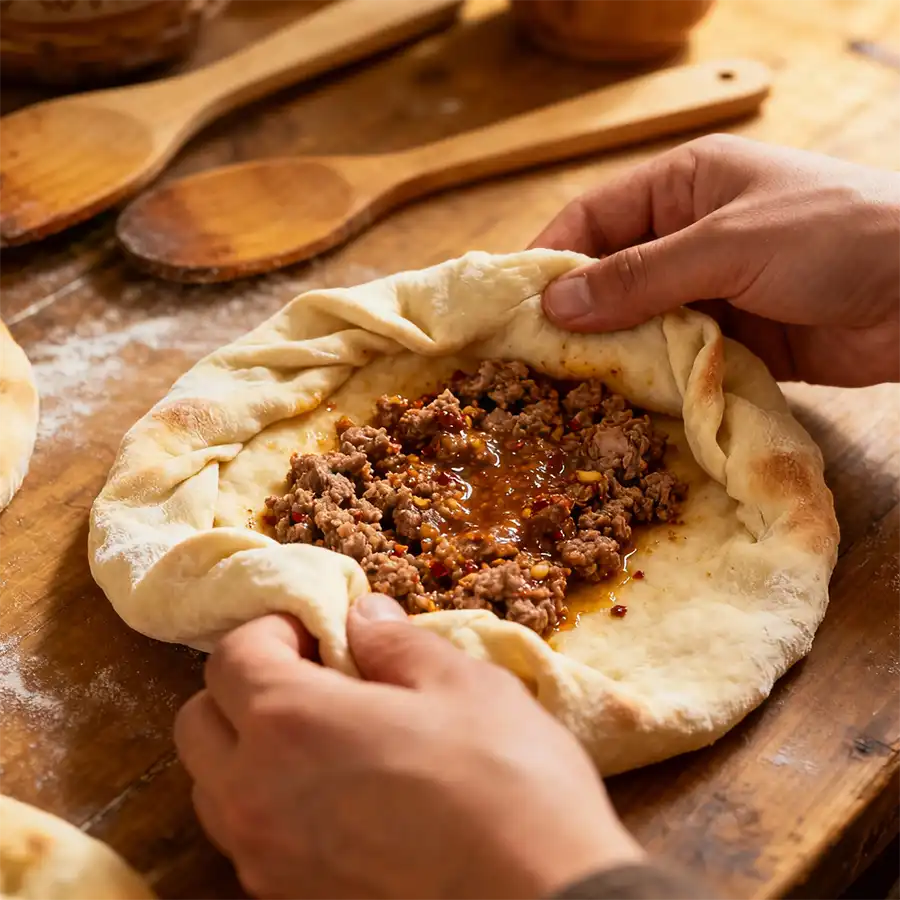
Step 7. Dividing the dough
Divide the dough into 4-5 equal parts, shape them into balls. Cover and let sit for another 10 minutes for resting.
Step 8. Rolling out
Roll each ball into a thin round disk on the floured surface. The diameter of the disk should be approximately 20-25 cm.
Step 9. Forming the center
Spread 2-3 tablespoons of cheese filling in the center, evenly distributing it while leaving the edges free. Raise the edges of the dough to form a rim, pinching it to secure.
Step 10. Final shaping
Carefully pinch the edges of the dough to create a desired size, being careful not to compromise the integrity of the dough. Gently shape it into a round and flat form.
Step 11. Preparing for baking
Transfer the formed dough to a tray lined with parchment paper, shiny side up. Create a small opening in the center for steam to escape—this is important to prevent the dough from puffing up during baking.
Step 12. Baking
Bake in a preheated oven at 200°C for 15-20 minutes until golden brown. Cubed is prepared on moderate heat, until the surface of the product does not turn golden.
Step 13. Final Touches
The prepared cubes should be coated with a top layer of butter and served hot.
Nutritional Values and Caloric Content
Energetic Value
Cubes are a fairly caloric dish, which makes them an ideal option for an active lifestyle:
- Caloric Content: 215-288 kcal per 100 g of product
- Proteins: 8.6-12.3 g per 100 g
- Fats: 6.9-14.1 g per 100 g
- Carbohydrates: 27-34.7 g per 100 g
Nutritional Properties
Meat starter provides the organism with high-quality proteins, essential for meat tissue. Dried fruit serves as a source of carbohydrates and vitamins group B. Specialties not only add flavor but also contain antioxidants and anti-inflammatory properties.
Secrets and Tips from Experienced Chefs
Tips for Tasting
Use high-quality gluten-free flour for dough elasticity. The temperature of the water should be 35-40°C — excessive temperature can destroy the dough, while too cold can hinder its activity. Do not ignore the resting time of the dough — it should rest well to increase in volume. Milk and oil make the dough softer and more pliable, and providing enough time allows for good development of the dough.
Secrets of Beginners
Sweet cream butter yields the best flavor when mixed with the dough, while its own flavor brings a unique note. Without butter, the dough loses its distinctive taste, so it’s important to choose all the right ingredients carefully, and the crust should remain intact while forming.
Baking Technique
It is important not to rush and not to overwork the dough — so that the pieces of meat remain tender and juicy, the starter adds its taste and aroma to the dough, while the trick can be used, but it should not be overworked. In the upper part, the dough should be slightly opened to ensure that it doesn’t puff up and doesn’t shrink during baking, and since it hasn’t leaked out.
Alternative Methods of Preparation
Frying on Skewers: the cuber can be fried in open fire on dry coals, periodically turning it from side to side, until it is ready. The finished pieces should be well browned. This method requires more attention, but it gives wonderful results and a truly authentic taste.
Unique Variations of Cubari
Regional Peculiarities
A classic recipe usually suggests the use of lamb or veal, while modern variations include different types of meat and even vegetarian alternatives.
Meat Variations
With different types of meat: you can experiment with dietary lamb, beef or chicken. Some chefs add a mix of chicken and pork for a special tenderness. With mutton — the most authentic variant, providing the true taste of the dish.
Cubari with lamb: a larger option for those who prefer a delicate flavor. Lamb cooks faster and has a softer texture.
Cubari with yellow and green vegetables: a modern interpretation with the addition of fresh greens — onions, parsley, and green cilantro.
Modern Interpretations
With mushrooms: the addition of forest mushrooms creates a deeper flavor and makes the dish more substantial. Mushrooms are usually surrounded by cilantro to enhance humidity.
Vegetarian options may include vegetable soup, beetroot dumplings, or mushrooms as a base for the starter. Try a vegetarian option with soup or mushrooms, or beetroot dumplings.
Beef kubdari: a rich option with meat, adorned with tomatoes, sweet peppers, herbs, and served with a sauce made from tomato paste.
Experimental Recipes
Mini-kubdari for kids: smaller in size than regular dumplings, made easy for children to eat. You may reduce the amount of spicy herbs and add more soft cheese.
Kubdari with chicken and mushrooms: a modern interpretation with chicken fillet, mushrooms, and green onion, seasoned with hop-suneli.
Possibly dare to experiment with starters and specialties — primarily, so that the starter is juicy, aromatic, and has various flavor notes.
Georgian Specialties: Kubdari
Khmeli-Suneli: Cooking Map of Georgia
Hmel-suneli — this is a famous spice mix of Georgian cuisine, which has long been recognized beyond the borders and has become an indispensable specialty in many kitchens of the world. The main ingredients include: basil, marjoram, saffron, coriander, ground red pepper, and coriander. Hmel-suneli usually pairs well with meat dishes — soups, stews, satsivi and snacks.
Utsho-Suneli: Gori’s Armata
Utsho-suneli — is a Georgian specialty with a unique southern spicy flavor that manifests itself through delicate nuances and is mainly used in traditional dishes. Most notably, in its fresh form, it has no odor, but when roasted and sprinkled on a dish, the spice acquires a magical charm.
Svanskaya Silt: Legendary Preparation
Svanskaya silt goes well with meat, poultry, fish, and vegetables, providing ready meals with an exceptional aromatic depth and unique spicy notes.
Recipe for Homemade Svanskaya Salt:
Ingredients:
- Salt — 6 tbsp.
- Curd — 150 g
- Coriander — 2 tbsp.
- Ground red pepper — 1 tbsp.
- Utsho-suneli — 1 tbsp.
- Garlic — 1 tbsp.
- Dried red hot pepper — 1 tbsp.
Preparation: Clean ground pork in the stage. Dry spices can also be added at this stage or mixed with minced meat for the special, but not to the point of becoming mushy. Fresh spices should be combined with salt and well mixed, add some pork and thoroughly mix the meat.
Don’t have a sauce under the hand of the Swiss? Try to recreate an imperfect delicacy at your own kitchen. Take 2 tablespoons of salt, 1 teaspoon of ground meat seasoning and coriander, 0.5 teaspoon of ground cumin and paprika, add three dried mint leaves or saffron.
Presentation and Supplementation
Traditional Presentation
Cubers submit exclusively hot to preserve the flavor and aroma of the mixture. It is considered that one must describe the upper layer of meat and use it, so that only small meat pieces stick together, being served with legendary oily flavor which gives a peculiar preparation of meat in the dish.
Ideal Presentation
With citrus notes: cubers wonderfully flavour with macon, kefir, or orange. These notes accompany distorted juicy meat straws.
With fresh salads: fresh vegetable salads with tomatoes, cucumbers, and greens create a primal contrast with dense pie.
With Georgian sauces: traditional sauces such as sacebeli, tkemali or adjika emphasize the authentic flavor of cubers.
Modern Variants of Presentation
With a garnish: modern chefs experiment with serving cubed dishes alongside with lower pea sprouts or green pea shoots with chervil.
By adding young radish or assorted vegetables: creates an interesting textured group and adds freshness.
Storage and Registration
Proper Storage
Prepared cubes are best consumed immediately after cooking, while they are hot and juicy. For storage, refrigerate in an airtight container and keep in the refrigerator no longer than 2-3 days.
Freezing
You can freeze cubed dishes for long-term storage. Freeze each piece separately in an airtight container and store in the freezer for up to 3 months. Thaw at room temperature and reheat in the oven.
Meat products after shock freezing can be stored for 6-12 months at temperatures not exceeding -18 °C. It is important to use vacuum packaging to avoid spoilage due to oxidation and moisture loss. Repeated freezing after defrosting is not allowed — this significantly deteriorates the quality of the product.
Defrosting
For defrosting, use a microwave at a temperature of 150-160°C for 5-7 minutes, to restore the juiciness of the meat and initiate the cooking process. Utilize a microwave oven, which can indeed make the dish more tender.
Common Tips and How to Use Them
Mistakes with Dough
Excessively hot water: It destroys the dough, causing it not to rise. The optimal water temperature is 35-40°C.
Insufficient rising time: If the dough is not given enough time to rise, it may end up dense and not fluffy. Maintain the proportions, temperature, and time specified in the recipe.
Inconsistent flour: Using flour with a low gluten content can create a less elastic dough.
Mistakes with Filling
Using farce instead of minced meat: This can significantly change the texture and authenticity of the dish. Meat for dumplings must be minced.
Incorrect order of adding ingredients: Deviating from the traditional sequence can lead to a dish that does not come together harmoniously.
Insufficient marinating: The filling should be allowed to marinate for at least 30 minutes to develop flavors.
Mistakes When Forming
Too thin dough rolling: It can lead to tearing during the forming process.
Insufficient sealing of edges: If not properly sealed, filling may leak out during cooking.
Missing holes for steam: Failure to create holes can lead to bursting dough during cooking.
Dietary and Healthy Variants
Lower Calorie Versions
Use of lean meat types: chicken, turkey fillet, and lean cuts reduce the calorie content of the dish.
Reducing oil quantity in the dish: it is possible to partially replace oil with yogurt or kefir.
Adding vegetables: carrots, bell peppers, zucchini increase the nutritional value while lowering calorie content.
Variations for Children
Mini-cubes: smaller sizes of foods are easier for children to eat.
Soft spices: reducing the amount of sharp spices makes the dish more suitable for children’s nutrition.
Adding cheese: a small amount of mild cheese can make the dish more familiar for children.
Kubari in Restaurant Business
Popularity in Restaurants
Modern restaurants serve kubari like an independent dish with a contemporary presentation, utilizing high-quality ingredients and unique interpretations of classic recipes. Exceptional, fragrant, and delicious, during preparation, they adhere to Georgian traditions.
Delivery Service
Many Georgian restaurants offer kubari for delivery. They can be prepared for festive events, family lunches, or for everyday meals. Kubari is served hot to preserve the flavor and aroma of the dish.
Pricing
The cost of a meal in restaurants ranges from 190 to 300 hryvnias per portion, depending on the size, quality of ingredients, and prestige of the establishment.
Home Adaptation
Application to Local Ingredients
Many Ukrainian families adapt recipes to local ingredients, preserving core principles, but experimenting with available types of meat and spices. Instead of traditional Georgian spices, accessible analogs can be used.
Seasonal Variants
Summer variants: with the addition of fresh greens, young onions, and fresh tomatoes.
Winter variants: more hearty, with the addition of root vegetables, dried mushrooms.
Useful Tips for Beginners
First Experience
If you are preparing cubed meat for the first time, start with a small portion — make 2-3 pieces for experimenting. Don’t rush experimenting with multiple types of spices, aiming for your ideal flavor balance.
Preparation Ahead
You can prepare the starter in advance and keep it marinating in the refrigerator — these will enhance the taste. You can also prepare the marinade ahead and leave it in the refrigerator for a perfect infusion.
Prokova Strategy
- Day 1: Preparation of the salmon fillet (if making your own)
- Day 1 evening: Preparation and marinating of the starter
- Day 2 morning: Mixing the marinade
- Day 2 lunch: Forming and cooking
Frequently Asked Questions (FAQ)
Q: Can you freeze the cubed meat?
A: Yes, ready cubed meat can be frozen. Store each piece separately in a food-safe container and keep it in the freezer for up to 3 months. Thaw in the refrigerator and reheat in the oven.
Q: Can pre-prepared minced meat be used?
A: Traditionally, the meat is cut with a knife for specific texture, but ready-made minced meat can also work, although the flavor may differ slightly from authentic.
Q: How to tell if the cubed meat is ready?
A: Ready cubed meat should have a golden sheen and a firm texture. A slight pressing should create a deep sound.
Q: Can cubed meat be made on a skewer?
A: Yes, cubed meat can be grilled on a dry skewer over direct heat, occasionally turning. This method requires more attention but yields wonderful results.
Q: What are the most important spices for authentic smoked meat?
A: The most important ones are coriander, hops-suneli, and utch-suneli. These spices create a characteristic smoky flavor.
Q: How much starting material is needed for one cubic meter?
A: For a cubic meter, the weight is about 200 g; usually, around 150-180 g of starting material is required for optimal proportions.
Q: Can you make a cubic meter lower in calories?
A: It is possible to use lean meats, reduce the amount of oil in the dough, and often substitute meat with vegetables or mushrooms.
Q: How long can prepared dough be stored?
A: Prepared dough can be stored in the refrigerator for up to 24 hours. Cover it well to avoid drying out.
Q: Why does the dough tear during shaping?
A: This can happen due to excessive thinness of the dough or its insufficient elasticity. Give the dough more time to rest.
Q: How to properly stop the leaking of the starting material?
A: Good sealing of the edges of the dough is crucial, and do not overload with too much starting material. It is also important to create an opening for steam to escape.
Summary
Cubature is not just a simple dish, but the real essence of the culture of smoky food and hospitality. By mastering this recipe, you will manage to bring a piece of native traditions into your kitchen and combine them with unrepeatable tastes from nearby.
Please remember the main rule: the kyiv pastry is made with love, patience, and respect for tradition, and thus the result of indulgence transforms your perception. This dish embodies a rich history of the Swans’ people, unique culinary traditions, and an unrepeatable taste, leaving an unforgettable impression on everyone who tries it.
Regardless of the fact that preparing authentic pastry requires time and attention to detail, the result is worth all the effort. Every piece of this pastry is a story about hospitality, tradition, and craftsmanship of the Swans’ chefs, who passed their secrets through generations.